


XRP Ledger (network) — a fast network for settlements and tokens
Overview
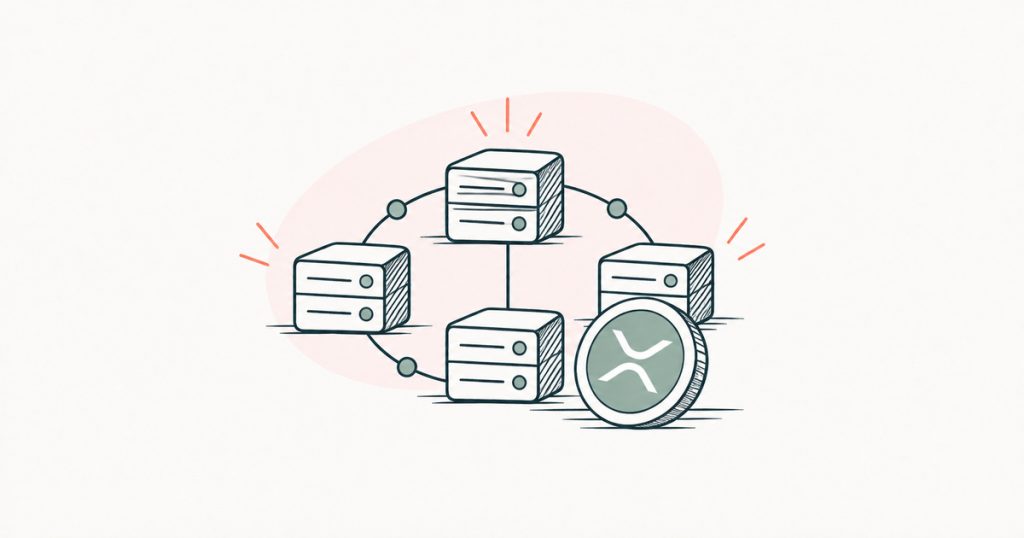
The XRP Ledger is a network for fast and cheap settlements, launched in 2012. Its main distinction is in how participants agree on records, not by a competition of computers and not by staked coins, but by the agreement of trusted servers, each of which decides for itself which other servers it trusts. The network’s native coin is XRP, its profile is in the article XRP.
How the XRP Ledger network works
The network is secured not by computation and not by staked coins, but by the agreement of trusted servers, and the XRP Ledger has its own way of doing this. Special servers, called validators, check against a list of those they trust, and this list is called the Unique Node List. Each server configures that list itself, there is no single “list of trusted servers for the whole network”. The mechanism of agreement was first described in the technical document (whitepaper) of the network’s creators3, while the current description is given by the network’s documentation1. This approach is covered in the article what is consensus as an example that beyond mining and staking it can also work another way.
Coins in the network are not mined, the entire XRP supply was created right at launch, which is called a premine (see issuance). A significant part went to the company Ripple and is largely held “under lock” in special escrow accounts, from which it is released gradually. The exact figures and the current distribution change, check the latest in.
The XRP Ledger is the network itself, while XRP is its coin, used to pay for operations. When people say “I bought XRP” they mean the coin (its profile is in the article XRP).
It is worth saying how this network is programmed too. The XRP Ledger was originally built around ready-made built-in functions rather than around a general programming language, the way Ethereum or Solana are. Full smart contracts in a general language are added to the network separately, for programs in Solidity there is an EVM-compatible companion network (a sidechain), and lightweight logic right on the main network is being developed under the name Hooks. This area is changing fast, check the current status in where to check: xrpl.org and the XRPL EVM documentation.
Without leaving the network you can send payments, exchange assets on a built-in exchange (a decentralized one, called a DEX, together with an automated market maker, AMM), issue your own tokens and create NFTs (the XLS-20 standard). For smart contracts in Solidity a separate EVM-compatible sidechain is used.
The XRP Ledger is an open network, while Ripple is a company closely connected to it that promotes XRP for payments. We do not retell the company’s legal history here (including the US regulator’s case, concluded in 2025), it is covered in the profile Ripple (company).
Current XRP Ledger network metrics
The number of validators and their distribution, the real speed and fees, the status of programmability (Hooks and the EVM sidechain) all change constantly, so check the latest in where to check: a network explorer and xrpl.org.
Assets of the network
Assembled automatically: all asset records whose asset_network = XRP Ledger (currently XRP; later tokens and NFTs of this network).
— Editor note (not published): EN mirror of Хаб_сеть_XRP_Ledger_RU — synchronous. Blockchain profile (hub assembly point). Hybrid + callouts [!note]/[!example] (2026-09-18). Replaces the earlier minimal stub. H1 “XRP Ledger (network) — a fast network for settlements and tokens”. RPCA whitepaper (Schwartz/Youngs/Britto, Ripple Labs 2014) as primary on the agreement mechanism; archive — TODO at seeding. Current description — xrpl.org consensus (archive 20260630140627). Owner pattern: how the network is programmed (no general language on mainnet; Solidity via EVM-compatible sidechain; lightweight logic Hooks in development — status) + what is built in (payments, DEX+AMM, token issuance, NFTs XLS-20). Source: Ripple, “Expanding programmability on the XRP Ledger”, verified 2026-09-18. Guardrails: UNL de-universalized; ASSET ≠ COMPANY (legal in Ripple (company), no verdict); premine without exact figure →. Hub slug: xrp-ledger (pair to coin xrp). New terms (Unique Node List/DEX/AMM/XLS-20/Hooks/EVM sidechain) in the missing-terms registry.