


What is crypto issuance?
In plain words
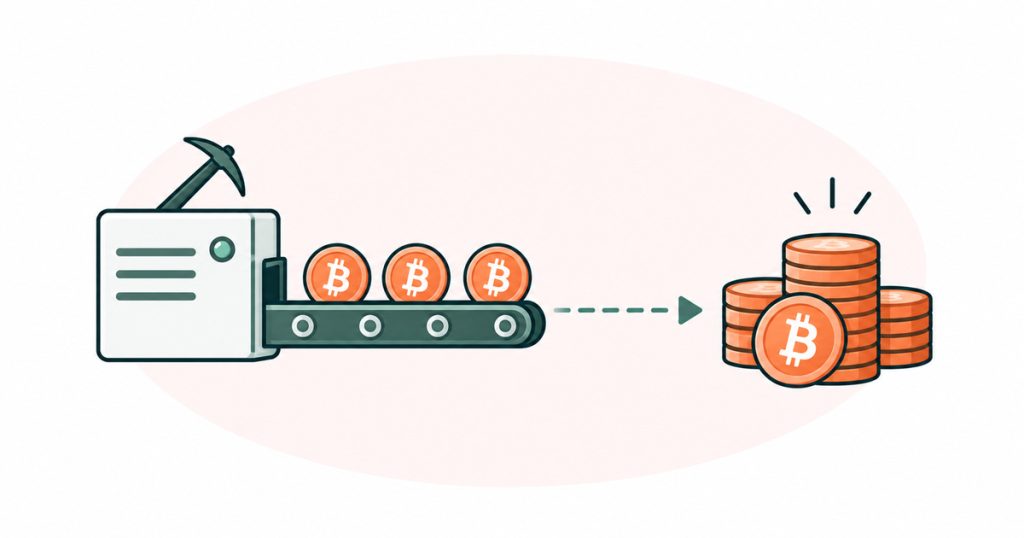
Issuance is how new coins appear in a network. It says how many coins can exist in total and on what schedule they are released. For ordinary money a central bank decides this. In crypto the rule is most often set in advance and written into code, rather than into someone’s snap decision.
Put simply, some coins have a capped run, like a collector’s edition, and no more of them will be printed. Others keep being issued, like an ordinary currency. That is what makes a coin more or less scarce.
Why does it matter to you? Issuance is one of the things that set coins apart, and it is worth checking in any coin’s description. There is an important caveat right away: a capped supply does not by itself promise a rising price. It is just one property of a coin, not a guarantee.
Deeper
Capped supply, the Bitcoin example
Bitcoin’s ceiling is set in advance, no more than 21 million coins, and new ones appear ever more slowly. Roughly every four years the reward for a new block is cut in half, an event called the halving, so over time issuance tapers off toward almost nothing. The very idea of a pre-set, decreasing issuance is described in Bitcoin’s original document1. Who issues new coins and for what is covered in the article miners and validators.
Unlimited or flexible issuance
Not every coin has a hard ceiling. In some networks coins keep being issued, and sometimes part of them is burned instead, that is, destroyed. Then the outcome depends on which is greater, issuance or burning. That is why how many coins there are in total is not always a fixed number.
There are two more caveats here. First, the issuance rules themselves are not always set in stone. In some networks they can be changed by the network’s governance through upgrades. Second, it helps to tell three different numbers apart. The maximum is how many coins can ever exist. The total issued is how many have been created so far. In circulation is how many are changing hands right now. These numbers do not always coincide, and the current values change all the time, so you look them up in a network explorer.
Premine, part of the coins created in advance
Sometimes a noticeable share of the coins is created right at launch, before any mining. This is called a premine. It is neither good nor bad in itself, but how the coins were distributed at the start is part of the honest picture of a coin. That is examined in the coin’s own profile.
Specific figures, such as how much has been issued so far and the current supply, change all the time, so you look them up in a network explorer.