


DAI — a decentralized stablecoin
How it works
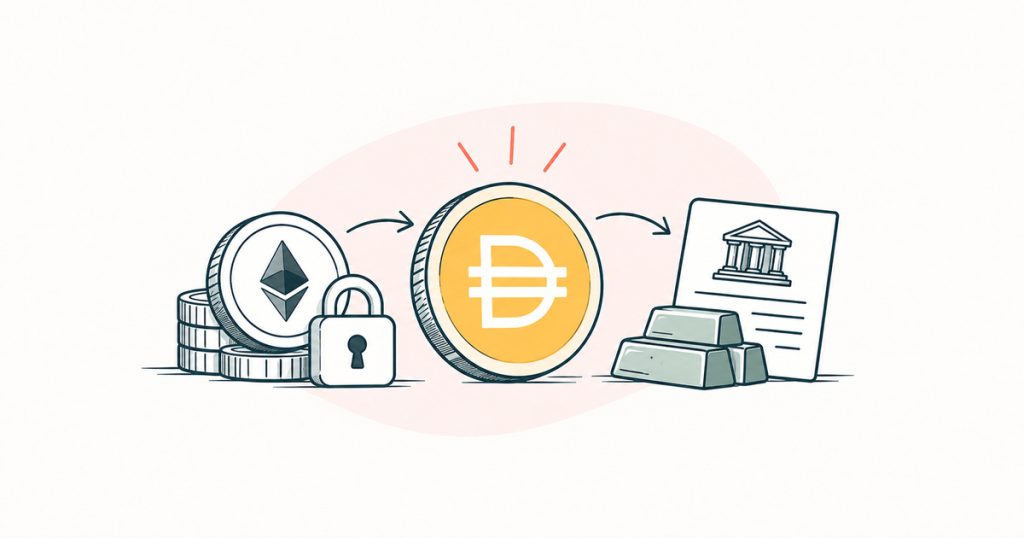
DAI is a stablecoin (a coin that holds the dollar’s price), but it is built differently from USDT and USDC. There is no single company with dollars in a bank standing behind it. Instead, DAI is backed by collateral locked in program-contracts: earlier the collateral was mostly other cryptocurrency, and with a surplus at that (more is put up than DAI is issued, in case the collateral’s price drops), and now real-world assets are increasingly part of the backing too. Everything is run not by a firm but by a protocol named Sky, that is, a set of programs and a community (this is the former MakerDAO). The shared mechanics of stablecoins are covered in what is a stablecoin.
The peg to the dollar (roughly one to one) is held not by money in a bank but by collateral in program-contracts, which are called smart contracts (see smart contract). Historically the collateral is cryptocurrency, and with a surplus: this surplus is called over-collateralization, meaning more is put into collateral than DAI is issued, as a cushion against a fall in price. Over time real-world assets (RWA in English) play a growing role too, for example tokenized government bonds and loans. The mechanism of crypto collateral with over-collateralization itself is described in the protocol’s technical document (whitepaper)3, while the current collateral composition is on the official site where to check: sky.money1.
DAI is issued and configured not by a single firm but by the decentralized Sky protocol (formerly MakerDAO), that is, a set of programs and a community. Hence a different set of risks than stablecoins with dollars in a bank: there is no one here to freeze funds “with one button”, but a dependence is added on the code, on the collateral’s price, and, as the share of real-world assets grows, also on the legal structures that stand behind them.
DAI has no hard cap either, but it is issued not by a company but by the protocol itself. New DAI appears when a user locks up collateral and is burned when they take the collateral back, so the amount of DAI in circulation follows the demand for such loans. How much is issued right now can be checked in where to check: sky.money. How coin issuance works in general is covered in the article issuance.
DAI’s crypto collateral is visible in the network’s shared history, unlike the check-reports of ordinary stablecoins (what are reserves). The plus is that everything is out in the open; the minus is that if the collateral crypto drops sharply, the system relies on the surplus and on automatic sell-offs of the collateral, and the part of the backing held in real-world assets is not fully visible on-chain.
DAI works as a token on Ethereum (the ERC-20 standard) and in other networks; for a transfer you pay the fee of the respective network, and when sending it matters that the network matches on both sides (see Ethereum, how to send crypto).
In 2024 MakerDAO renamed itself to Sky and issued a new stablecoin, USDS, as DAI’s successor. DAI itself is not closed and works (its contract cannot be changed), and the DAI-to-USDS one-to-one exchange remains voluntary2. In 2026 some exchanges converted users’ DAI balances into USDS, but this concerned only money kept on the exchanges themselves, not in personal wallets. Before storing it for a long time, check the current status: where to check: sky.money.
Where to check current DAI data
What is in the collateral and in what state (the share of crypto and of real-world assets), the status of DAI and of the move to USDS, the list of networks: where to check: sky.money. Price and market cap:.
Properties
- A "dollar in the wallet": transfers and storing value
- Blockchain apps where decentralized backing without a single intermediary company is valued
The backing here is mixed, so reliability depends on the price of the crypto collateral and on how the surplus-and-sell-off mechanism fires, while for the real-world-asset part it depends on the credit and legal risks of whatever stands behind them (see what is a stablecoin).
A dependence on program-contracts and on the protocol’s decisions does not remove risks; it merely replaces them with a different set. “Stable” does not mean “risk-free”: a break from the peg (a depeg) is possible (depeg).