


LINK (Chainlink) — the oracle-network token
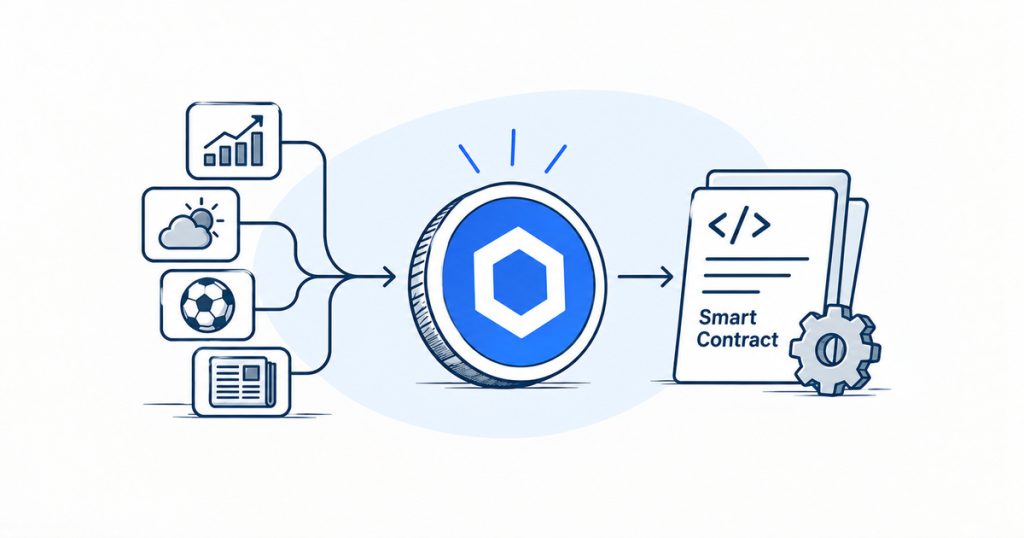
How it works
Smart contracts (the small programs that run on a blockchain) do not, by themselves, know what is going on in the ordinary world: an exchange rate, a match score, the weather. An oracle is a service that brings such outside data into the blockchain, and Chainlink is exactly a network of such oracles, one that delivers verified outside data to smart contracts. LINK serves as the token of this network, and its services are paid for in it. So LINK belongs to the “utility” (service) tokens, needed for one specific service to work rather than for voting or as a wrapper over another coin (what a token is in general is covered in the article what is a token).
LINK is a token, that is, a crypto-asset with no separate network of its own, and it works on Ethereum (under the ERC-20 standard) and on other networks. It only makes sense together with the Chainlink oracle network, and outside it, it is just a token. The very idea of a decentralized oracle network that brings outside data to smart contracts was described in Chainlink’s technical document (whitepaper)3, while a later version, Chainlink 2.0, describes how the network evolves further4.
The token has two main roles. First, LINK serves as payment for oracle services, and an app that needs outside data pays for the network’s work in it. Second, LINK is used in staking, where holders put it up as a pledge of honest work and so add reliability to the network. The set of functions and the parameters change over time, so the current values are best checked directly on the official page1.
Imagine an insurance smart contract that is supposed to pay out on its own if a flight is delayed. But how would the contract learn about the delay, if it does not go online itself? This is exactly where an oracle is needed: Chainlink brings the contract the verified fact “the flight is delayed”, and the contract fires. In the same way oracles feed exchange rates, prices and other data into the blockchain, and a great deal of apps rest on them (see smart contract).
On networks like Ethereum staking works as a stake for the right to validate blocks, while on Chainlink staking LINK serves as a pledge of honest data delivery, and if a participant cheats, they risk their stake. This is a different role than staking for the work of the network itself.
Properties
- Payment to data providers in the Chainlink oracle network
LINK’s value is tied to how much the Chainlink network itself is in demand, since if there is no demand for its services, the token loses its point. Like any token, LINK depends on its network, and its price can swing sharply.
LINK’s price is not pegged to the dollar and can swing sharply in both directions. It is a service token of a specific network, not a “stable” coin and not a share in a company.