Skip to content
CRYPTAURUS
Ethereum › UNI (Uniswap) — the token for voting on the exchange
Ethereum

UNI (Uniswap) — the token for voting on the exchange

Uniswap · also: UNI, Uniswap, Uniswap token, UNI crypto
UNI is the Uniswap exchange token that gives a vote on how it develops further. How voting works, why the exchange's fees burn UNI, how it differs from a stock, and the risks.

UNI in plain words

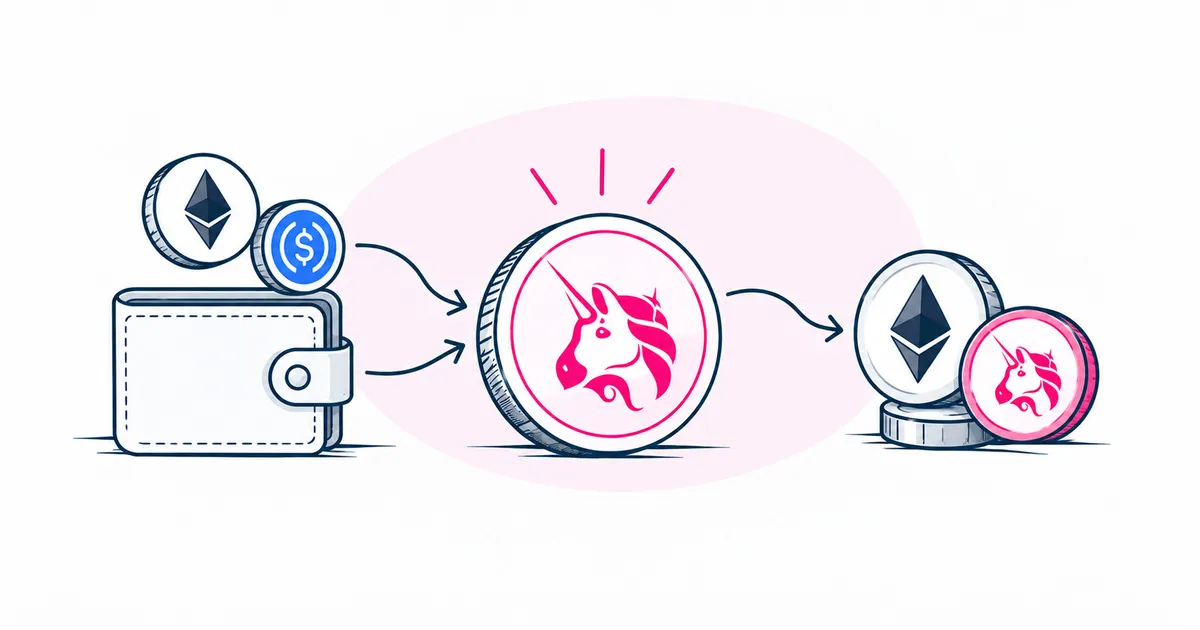
The Uniswap exchange works without a middleman company and is like a swap machine with no cashier. You put in one cryptocurrency and get another, and the machine works out the rate by itself from how much of each it holds. There is more about it on the Uniswap page.

Holding UNI gives you a say in how this swap machine works: what fees to charge, what to spend the shared money on and which upgrades to accept (what is a token).

People got UNI in an unusual way. In September 2020 anyone who had used Uniswap before 1 September could claim 400 UNI for free, and those who had put their own cryptocurrency into the swap machines got more, so part of the votes went straight to ordinary users1.

The value of UNI rests on demand and on how useful the vote itself is. The exchange's income is not paid out to holders.

Objective data
Objective data
Classa token that runs on top of other networks, such as Ethereum
TickerUNI (the label it carries on exchanges)
Tied tothe Uniswap exchange
What it is forvoting on the exchange's rules
NetworksEthereum and several others
LaunchedSeptember 20201
Supply at launch1 billion UNI tokens2
New tokensholders can vote to issue new ones, but they have never done so23
Burningsince December 2025, first 100 million tokens at once, then little by little from fees4
Deeper

How the UNI token works

How UNI holders vote

Picture a residents' meeting in an apartment building, where each vote depends on the size of the apartment. On Uniswap your vote depends on how much UNI you hold, and the more tokens you have, the more votes you get.

For your vote to count, you have to switch it on once in your wallet beforehand, that is, assign your vote to yourself or to a representative, like giving a neighbor power of attorney. The tokens stay with you, and whoever you assigned the vote to does the voting. Many holders skip this and never take part in votes56.

As at a meeting where one resident owns ten apartments, the final say often belongs to those with a lot of UNI or a lot of delegated votes, while the vote of someone with a couple of tokens changes almost nothing.

What UNI holders have already decided by vote

The main recent decision came in December 2025. Almost unanimously, with 99.9% of the vote, holders approved a package of changes called UNIfication. It switched on a fee paid to the exchange itself and burned 100 million UNI from the project's shared treasury in one go74.

How the exchange's fees destroy UNI

The whole swap fee used to go to the people who had put their cryptocurrency into the "machine", known as liquidity providers. Since December 2025 a small share of the fee goes to Uniswap itself, and in 2026 this has been switched on in many Uniswap swap machines and on many networks78. For example, in machines with a 0.3% fee, out of every 30 cents of fee on a $100 swap, 25 cents go to the providers and 5 cents to the exchange.

This money, in various cryptocurrencies, builds up in a special piggy bank, which is really a separate program, a smart contract. Nobody can simply take it out, neither the team nor the holders.

The piggy bank opens in only one way: by destroying, that is burning, a set amount of UNI for good. Whoever finds it worthwhile does this. Once the piggy bank holds more than the UNI needed to open it is worth, someone burns those tokens and takes the contents. In this way the exchange's fees keep turning into destroyed UNI. Holders get no cash from it, but the number of tokens falls, and the more people swap cryptocurrency on Uniswap, the more UNI gets burned.

If demand for the token has not dropped, the remaining UNI becomes scarcer, although that is no guarantee the price will rise.

How much UNI there is and why the number changes

  • In 2020, 1 billion UNI were created. About 60% went to the community, and the rest went to the team, investors and advisers, released gradually over four years2.
  • New tokens don't appear on their own. Holders have the right to vote for issuing up to 2% a year, but no such vote has taken place23. How issuing new cryptocurrency works in general is covered in what is issuance.
  • Since December 2025 UNI is being burned, and the future amount depends on how much is swapped on the exchange. Check how many tokens have been burned to date on a block explorer.
    where to check: network explorer, e.g. blockchair.com

How UNI differs from a stock and ETH

To see where UNI fits, compare it with a company's stock and with ETH, the coin of the Ethereum network used there to pay the fee.

How UNI differs from a stock and ETH
UNIStockETH
Does it give a vote on decisions?yesyes1no
Does it pay dividends?novariesno
Does it give a stake in a company?noyesno
Is it needed to pay the network fee?nonoyes
Does part of the fees go to burning?yes2noyes
Can the price fall sharply?yesyesyes
  1. At a shareholders' meeting. ↩
  2. Since December 2025. ↩

In Ethereum, part of every fee is burned too, and it has worked this way since 20219; you can read about the coin itself in Ethereum. Neither a vote nor burning protects against a price drop on its own.

Pros and cons of UNI, a stock and ETH

UNI
  • Pro: gives a vote in decisions about the exchange
  • Pro: the exchange's fees gradually reduce the number of tokens
  • Con: no dividends and no share of the company
  • Con: votes are concentrated among large holders
Stock
  • Pro: gives a share in a company and its profit
  • Pro: the rules for stocks have long been well established
  • Con: can usually be bought only through a broker
  • Con: trades on the stock exchange's schedule
ETH
  • Pro: needed by everyone who uses the Ethereum network
  • Pro: part of the network's fees is burned
  • Con: gives no vote on decisions
  • Con: its price swings sharply

UNI is closer to a vote at a meeting than to a stock. It shapes the exchange's rules, while the holder has no right to its profit.

UNI token risks

  • The price of UNI swings a lot, and burning does not guarantee that it will rise. See how the price has moved.
    where to check: crypto aggregator, e.g. coinmarketcap.com
  • Burning depends on the exchange's trading volume: the fewer swaps on Uniswap, the less fee income and the less UNI gets burned.
  • Decisions may be made in the interests of large holders and of those who have collected many delegated votes.
  • The legal status of voting tokens is not yet clear everywhere ⚖️: different countries treat them differently, and a change in the rules could affect both the exchange and the token.

Where to check current data

How much UNI has already been burned and how much is in holders' hands right now (in circulation) is shown on a block explorer, that is, a website where you can see every record on the network.

where to check: network explorer, e.g. blockchair.com

Votes running right now appear on the Uniswap voting site.

where to check: Uniswap voting site, e.g. vote.uniswapfoundation.org

Look up the current price and trading volume on a crypto data aggregator.

where to check: crypto aggregator, e.g. coinmarketcap.com

More detail on other decisions by UNI holders

Holders also decide how the project's treasury is spent. In early 2025 they allocated money from it to develop Uniswap and its own network, Unichain10. The same year the holder community was set up as a nonprofit association in the US state of Wyoming, so that it has rights and protection within the ordinary legal system ⚖️11. The token's role was changed in 2025 by proposals from the team, which holders then approved by vote12.

The fee for the exchange was switched on step by step. In March 2026 it was turned on in all version v3 machines (pools) on Ethereum and on eight more networks813. In July 2026 it followed in the pools of the exchange's new version (v4) on seven networks, and on the Robinhood Chain network as well1415.
Frequently asked questions

Does UNI pay dividends?
No. The exchange's fees go toward burning UNI, and no money is paid out to holders.
What is UNIfication?
It is the name of the December 2025 package of changes that started the burning of UNI from the exchange's fees.
How much UNI is there in total?
At launch, 1 billion tokens were created. None have been added since, while some UNI has been burned since December 2025.
Can I still get UNI for free, as in 2020?
No. That giveaway of 400 UNI was a one-off for early users of the exchange, and nobody has promised to repeat it.
Sources
They back the facts above. Changing figures aren't published — for those we link to "where to check".
1Introducing UNI blog.uniswap.org ↩Verified 20.10.2026 · primary source
2UNI developers.uniswap.org ↩Verified 20.10.2026 · primary source
3Understanding the Uniswap DAO Mint Function gov.uniswap.org ↩Verified 20.10.2026 · primary source
4Uniswap executes 100M UNI burn after fee switch approval cointelegraph.comsecondary ↩Verified 20.10.2026
5Guide to Voting developers.uniswap.org ↩Verified 20.10.2026 · primary source
6RFC: Governance Logistics Improvements gov.uniswap.org ↩Verified 20.10.2026 · primary source
7Uniswap passes UNIfication proposal theblock.cosecondary ↩Verified 20.10.2026
8Protocol Fee Expansion: Vote 2 vote.uniswapfoundation.org ↩Verified 20.10.2026 · primary source
9EIP-1559: Fee market change for ETH 1.0 chain eips.ethereum.org ↩Verified 20.10.2026 · primary source
10Uniswap Unleashed vote.uniswapfoundation.org ↩Verified 20.10.2026 · primary source
11Establish Uniswap Governance as 'DUNI,' a Wyoming DUNA vote.uniswapfoundation.org ↩Verified 20.10.2026 · primary source
12Hayden Adams' UNIfication proposal heads to final governance vote theblock.cosecondary ↩Verified 20.10.2026
13Uniswap governance considers activating protocol fees on all v3 pools, expanding to eight additional chains theblock.cosecondary ↩Verified 20.10.2026
14Activate v4 Protocol Fees (Part 1/2) vote.uniswapfoundation.org ↩Verified 20.10.2026 · primary source
15Protocol Fee Expansion: Robinhood Chain vote.uniswapfoundation.org ↩Verified 20.10.2026 · primary source