


ENS (.eth name) — a readable name instead of an address
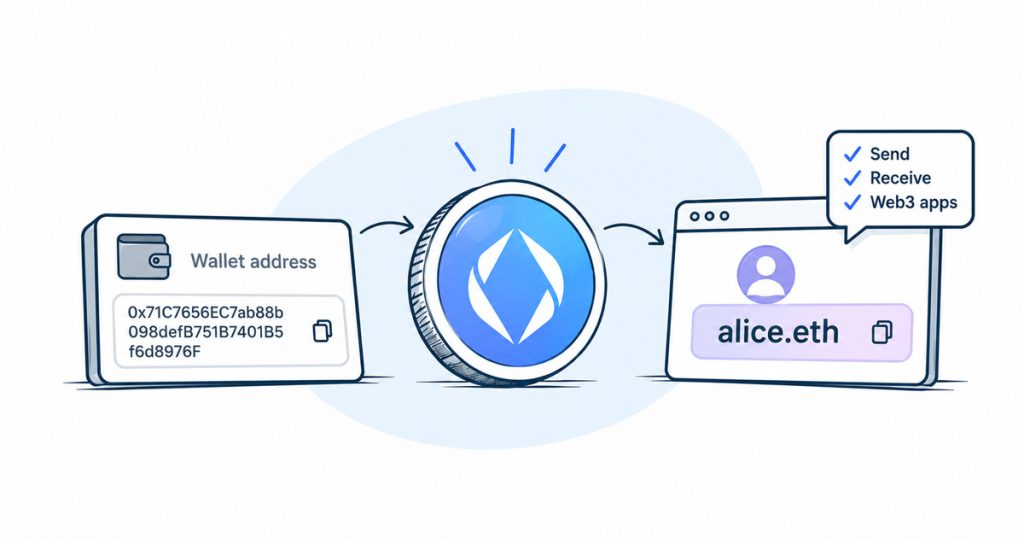
How it works
Crypto addresses are long and unreadable, a string of the form “0x…”. ENS (Ethereum Name Service) lets you set up a friendly name like alice.eth and tie it to your address, so instead of a set of characters you give a simple name. This name itself is technically an NFT, that is, a unique token registered to you1. It is a clear example of a useful NFT, since the value here is not in a “picture” but in a function, in convenience and recognizability (what an NFT is in general is covered in the article what is an NFT).
A .eth name is a unique token (an NFT) on Ethereum, and its value is not in a picture but in the fact that the name works as a pointer to your address. That mapping is handled by a “resolver”, a program that translates a name into an address (more on the protocol itself on the ENS-as-a-service page). A friendly name is also handy because it lowers the risk of a mistake when sending, since checking a name is easier than a long address, though you should verify all the same (see how to send crypto).
Such a name works not in an ordinary browser like a website, but inside the crypto world, in wallets, on exchanges and in blockchain apps that support ENS. Anywhere you would normally paste a “0x…” address, you can enter a name like alice.eth, for example to send coins to it or to log in to an app with it. The spelling looks like a website address (.eth next to the familiar .com), but it is not a website, it is a pointer inside the blockchain.
It is important not to confuse two things. ENS is also the service itself, the whole naming system as a whole, while here we describe the ENS name as an asset (an NFT). One and the same brand is represented by two different entities, so as not to mix them up.
A .eth name is not bought once and for good, it is taken for a term and renewed, like a lease. If you miss the term, there is a grace period (around 90 days) during which the name can still be reclaimed. After it, the name is released and someone else can take it, that is, a name you have tied can really be lost. Terms and prices are in where to check: ens.domains.
Around popular names, look-alikes and typos spring up (alice.eth and near-copies). Always check which address a name actually leads to, otherwise you can send money to the wrong place (see phishing and scams).
Why people get an ENS name
Without advice, just as it is: a .eth name is taken in order to give people a simple name instead of a long address and to have it recognized across different wallets and apps. This describes why people get it, not advice.
Where to check current ENS name data
A name’s term, the tied address, the cost of registration and renewal are in where to check: ens.domains.
Properties
- A readable name instead of an address: convenience and recognizability when sending
An ENS name is convenient, but it is not “forever” property, it is a binding you have to renew, or you can lose it. And as with any pointer-name, safety here is largely about attention: check who and what address you are dealing with (see phishing and scams).