What are phishing and scams in crypto?
Phishing and scams in plain words
Picture a call "from your bank". The caller knows your name, sounds confident and asks you to read out the code from a text message to "stop a suspicious payment". Nobody has touched the banking system, and the money disappears because you gave the code yourself. Phishing phishing in crypto works the same way. The scammer fakes something you already trust, such as an exchange's site, a wallet app or a support message, and waits for you to take the step they need. The name sounds like the English word "fishing", and phishing works in a similar way: the bait is cast to thousands of people, and the scammer waits to see who bites.
Scam scam is a broader word. It covers any fraudulent scheme whose goal is your money, even if nothing in it is faked. A website promising to double the bitcoin you send, or an "investment platform" that appears in no official register, may not pretend to be a well-known brand and still be a scam. Scammers gain when you have no time to think, so many schemes rush you: "the offer is valid for one hour", "your account will be blocked unless you confirm now".
Crypto suits scammers because a confirmed transfer on the blockchain cannot be reversed, and your own wallet has no bank behind it to hold a suspicious payment. Crypto sent to a scammer can usually be recovered only if the recipient sends it back1. In the US alone, people reported crypto fraud losses of about 11.4 billion dollars to the FBI for 20252.
What common crypto scams look like
Lookalike websites and fake ads
A lookalike website lookalike website (phishing site) copies the design of an exchange or a wallet, while its address differs from the real one by a single letter, an extra word or a different ending. A link to it arrives in an email or a message, and sometimes scammers buy search engine ads for it. In 2022 the FBI warned that such ads can appear at the very top of search results and pose as crypto exchange websites to steal login details3.
The habit that protects you from a lookalike site is never opening your exchange or wallet from a link. Type the website address by hand or open it from a bookmark you made yourself3. A seed phrase is needed only to restore a wallet in the wallet's own app (what is a seed phrase), so a website that asks you to enter it is fraudulent, however familiar it looks.
Fake support
Fake support writes or calls first, introduces itself as an employee of an exchange or wallet company and offers to solve your problem. Then it asks for your seed phrase or for a crypto transfer "for verification". Scammers impersonate well-known companies, as well as government agencies and the police1. Real support for the MetaMask wallet, for example, never asks for a seed phrase and never messages first offering help. Anyone who phones you in its name is trying to deceive you4.
If you need help, contact support yourself through the official website or app. Do not reply to "staff" who found you first.
"Giveaways" and crypto doubling
A "giveaway" promises free crypto or to double whatever amount you send. In July 2020, hackers took over the Twitter accounts of politicians and celebrities, promised in their name to double any bitcoin sent to them and collected more than 100,000 dollars this way5. A promise to double the crypto you send, in other words "free money", is always fake1. Genuine token giveaways do exist, yet they never ask you to send crypto first or to enter your seed phrase.
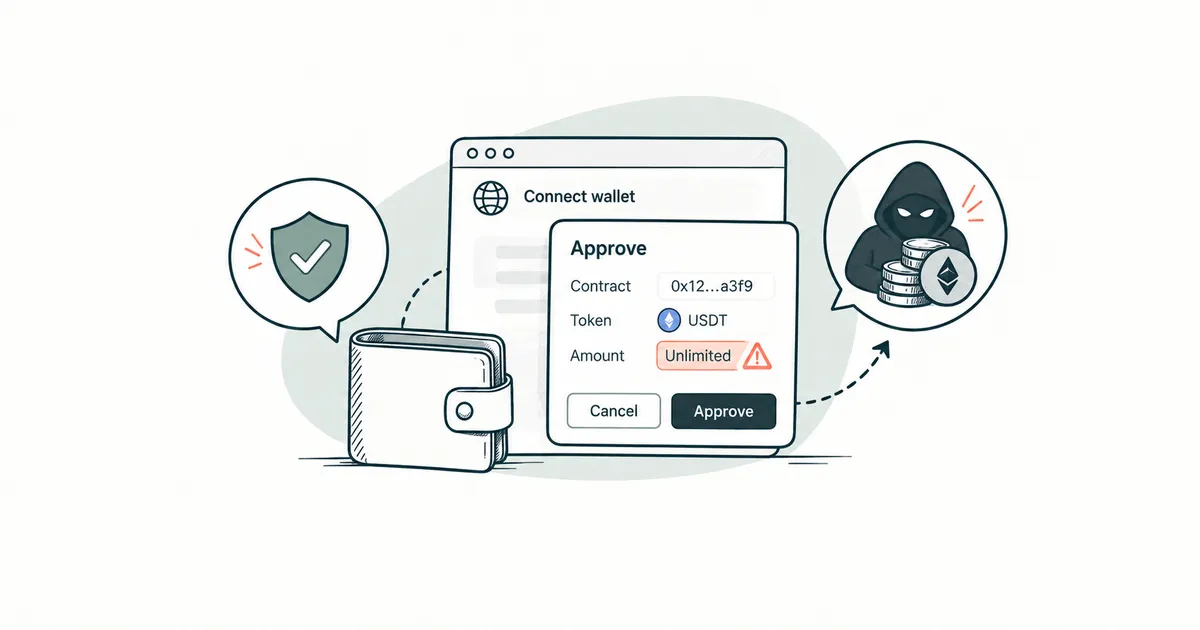
There is also a "giveaway" that asks you to send nothing. An unknown token appears in your wallet (a token is crypto issued on top of someone else's network), and you are invited to a website where you can supposedly claim or swap it. A token sent to your address does not by itself give anyone access to your money; the fraud happens on the website the bait leads to6. So do not sell or swap an unknown token, and do not open the websites that mention it. A "giveaway" site may skip the seed phrase and ask you to press "Confirm" in your wallet, and by doing so you may allow the site to take your tokens. The article wallet connection safety explains what to check in the signature window and how to revoke such a permission.
Address swapping in your transfer history
Address swapping address swapping (address poisoning) preys on the habit of copying the recipient's address, the number of their "account" on the network, from your transfer history. The scammer creates an address whose beginning and end match an address you recently sent money to, and sends your wallet a transfer of a negligible amount, usually zero. A similar address appears in your history, and on your next transfer it is easy to copy it by mistake7.
It is like a call from a number that differs from a friend's number by a couple of digits in the middle. The number stays in your call log, and if you call back from there without looking, you reach a stranger.
That is why you should never take the recipient's address from your transfer history. Save verified addresses in your wallet's address book, and before sending, check the whole address, especially the characters in the middle7. The guide to sending crypto shows how to send a transfer without mistakes in the network and the address.
Fake investments and online acquaintances
A fake investment platform shows growth on screen that does not exist and does not pay out when you try to withdraw. Often a long online acquaintance leads to it. The scammer writes as if by mistake, to the wrong person, or gets to know you on social media or a dating app. Over weeks they build trust, then invite you to an investment website or app that looks real and is fully under their control. The platform shows unusually high returns, and when the person tries to withdraw, it demands a "tax" or an "early withdrawal fee"8. Keep online dating and investment advice apart. Only scammers guarantee a profit or a big return1.
Before you invest money through a company or platform, check whether it has a licence from your country's financial regulator, that is, the government body that licenses financial companies, and whether it appears on a list of illegal companies. Being absent from such a list guarantees nothing, while being on it settles the question at once.
"Recovery" services for stolen crypto
After a fraud, victims are often found by a second wave of scammers. They pose as lawyers, a "recovery service" or government officials, promise to get the stolen money back and ask for payment up front. In 2024 and 2025 the FBI warned about fake law firms. They contact victims first, claim links to government agencies, know the exact amounts and dates of earlier transfers and demand payment in crypto or gift cards910. For 2025, the FBI received reports of losses to such schemes of about 1.4 billion dollars2. Police in the US do not charge victims for investigating9.
Rules that protect you from phishing and scams
What to do if you have already been scammed
- Stop all transfers and stop replying to the scammer.
- If the scammer has learned your seed phrase or your private key, create a new wallet with a new seed phrase and immediately move everything left in the old one there.
- If you signed a permission on a suspicious website, revoke it as described in wallet connection safety.
- If you entered your exchange password on a lookalike site, change it through the exchange's official app, check your two-factor protection settings (2FA, the second code at login) and contact the exchange's support.
- Save the wallet addresses, the transfer hashes transaction hash, that is, their numbers on the network, the website addresses, the messages and screenshots. Include every detail of the transfer in your report2.
- Report the fraud. If the transfer went out from an exchange, contact its support1. If you paid by card or bank transfer, contact your bank right away and ask for the payment to be reversed, because speed matters here2. In any case, file a report with the police in your country. where to check: in the US, complaints are taken by the FBI's IC3 centre at ic3.gov and by the Federal Trade Commission (FTC) at ReportFraud.ftc.gov
- Ignore anyone offering paid recovery of your money.
Can you get back crypto that scammers have taken?
Usually not, if the transfer went to a wallet that only the scammer controls. A chance appears when the stolen funds reach an exchange or a company that can block them at the request of the police. In November 2023, for example, Tether, the company that issues USDT, froze about 225 million dollars in USDT linked to fake investments11. File a police report whatever the amount lost, even a small one2.
More detail on an example of a fake wallet ad
In 2021, Check Point Research found fake websites of the Phantom wallet in Google ads, through which people lost more than 500,000 dollars12.