


Staying safe when connecting a crypto wallet
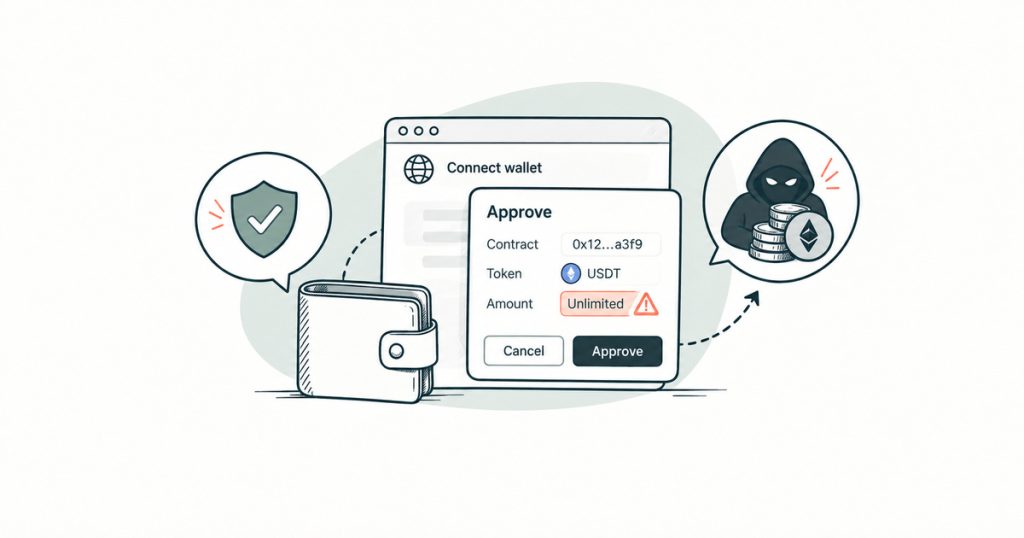
In plain words
When you connect your wallet to a site or app, the risk is not in the connection itself, but in the rights you grant that site when you press Allow. The connection only lets the site see your address and ask you for signatures. On its own that is not yet a risky action. What is risky is what you confirm afterward.
The main such right is called approve, that is, a permission. With your signature you hand a smart contract something like a power of attorney over your token: you let it spend that token whenever the site needs to. For an honest swap this is convenient, but the power of attorney stays in force after the deal too, until you revoke it yourself, and if it falls into the wrong hands or you granted too broad a one, it can be used against you.
Remember right away: connecting a wallet and approve never require a seed phrase. Any request to enter a seed phrase on a site is fraud, which the articles phishing and scams and what is a seed phrase cover.
Deeper
What you are really signing, and where to look
When a site asks for a signature, the wallet shows a window with the details. Train yourself to read three things in it: which contract, that is which address, you are giving the right to, which token, and for what amount. Those three fields are exactly what tells you what is being asked of you.
Signatures come in different kinds, and it is important to tell them apart.
A plain sign-in signature just confirms that the address is yours. It spends nothing and changes nothing on the blockchain, so it is safe, and agreeing to it is fine.
A permission to spend your token, that same approve, is already a right to dispose of money, and here you need care. A danger sign is when the permission amount is not limited at all, which is called an unlimited approve. An unlimited permission is convenient because it does not ask again at every deal, but it is also more dangerous: if the contract turns out to have a vulnerability or is malicious from the start, your whole balance of that token is at risk, not a single one-time amount. So when the wallet lets you choose the amount, it is better to limit it to what the specific operation needs.
There are also signatures that look harmless but in essence open access to money too. Some of these permissions are free and not immediately visible on the blockchain. For example the permit mechanism, and in newer apps the shared Permit2 mechanism, where one permission works for several services at once and has its own limit and expiry. By their consequences they are the same approve, just signed a different way. The rule here is simple: if you do not understand exactly what is being asked and for what amount, do not sign.
How funds are drained: phishing and plain fraud
It is worth telling two traps apart.
The first is phishing, that is, a fake. You are brought to a look-alike of a real exchange or wallet: the picture is the same, the address is someone else’s. You enter your data or sign an approve, thinking you are dealing with a known service.
The second is ordinary fraud, where the site does not pretend to be anyone else at all. It can be a super-exchange with no fees or a generous giveaway, a seemingly standalone service that did not exist before. Nothing needs to be faked: it is enough to lure you with a bargain and get one broad signature.
After that both cases are the same: the malicious contract uses the granted right and moves your token out. The blockchain is not hacked here, since you signed the access yourself, and a transfer cannot be reversed after the fact. That is why you protect yourself before the signature, not after.
How to connect and sign safely
There is one main rule: do not connect a wallet holding your main money to just anywhere. The fewer sites have seen your main address and received signatures from it, the calmer you can be.
If you are going to try things out or visit new sites, set up a separate wallet for that and keep only a small amount on it for the specific task. Yes, you will have to keep a little of the network’s coin on each wallet for fees, but that is exactly the price of insurance: even if you sign something bad, there is almost nothing to lose on a separate wallet. Your savings meanwhile stay apart, and how to store them is covered in the article how to store crypto.
Then come the everyday habits. Understand exactly what you are allowing: before signing, look at the contract, the token, and the amount, and if something is unclear, do not confirm. Where you can, limit the permission amount to the needed minimum instead of an unlimited one. From time to time revoke old permissions you no longer need: such a revoke is itself an operation with a network fee, so it is convenient to clear them out in one go. Finally, reach sites by hand, by a verified address, not via links from ads and emails, checking the contract address (see phishing and scams).
A hardware wallet helps doubly here: it shows the signature details on its own screen, so you see what you are confirming even if the computer is infected.