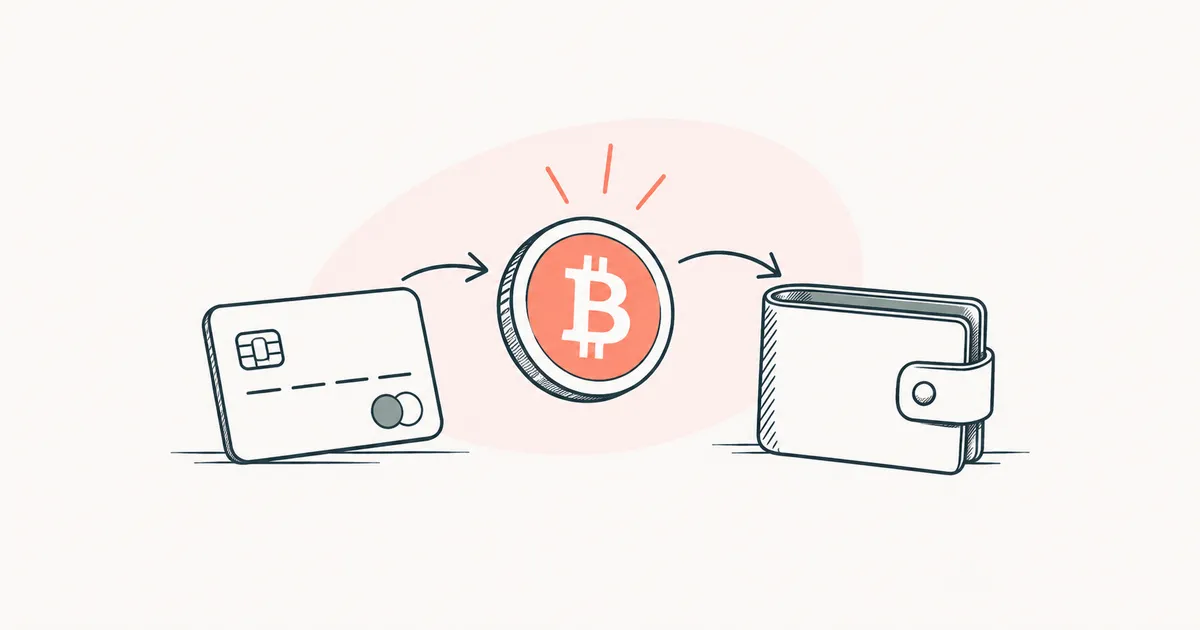
Crypto is sold for ordinary money on an exchange, through an off-ramp provider (a company that buys crypto straight from your wallet), or to another person on a P2P platform, where the deal is made directly and the platform holds the crypto until payment arrives. The money is then withdrawn to your own bank account or card. To get cash, you sell at an exchange office with a physical branch, or meet the buyer in person for a deal opened on a P2P platform, if the platform allows that payment method.
crypto in an exchange account or in your own wallet that you can access;
an account that has passed the identity check (KYC), when a service asks for an ID and a selfie, like a bank opening an account. It is required even when you sell from your own wallet, for example through the off-ramp provider MoonPay2;
Used for sell in your account and withdraw money to a bank
Pro: the exchange, a company, pays you
Pro: trade and withdrawal history is kept
Con: you need a verified account
Con: withdrawals in your currency are not everywhere
On an exchange, a sale takes two steps. First you sell the crypto and the money appears in your account balance in local currency; then, in a separate operation, you withdraw it to your bank3.
Off-ramp provider
MoonPayTransak
Used for sell straight from your own wallet
Pro: no exchange account needed
Con: not available in every country
Con: terms depend on the payout method
An off-ramp provider sends the money for your crypto to a bank account or card24. Each one has its own list of countries and payout methods.
where to check:the service's sell page, list of supported countries
P2P platform
Binance P2PBybit P2P
Used for sell to a person for a local payment method
Pro: you can pick a familiar way to get paid
Con: you check the payment yourself
Con: risk of fraud and a blocked account
On a P2P platform you sell crypto to another person, who pays you directly, usually by bank transfer. The platform works like a middleman holding your goods: the buyer pays you, and the middleman hands the goods over once you confirm the money has arrived. This holding is called escrow escrow. The platform is not a party to the deal, though, and is not obliged to step into a dispute between you and the buyer5.
Exchange office
Used for get cash in hand
Pro: money straight away in cash
Con: check the office's license
Con: meeting with cash calls for caution
An exchange office you can walk into takes your crypto and pays out cash on the spot. How to compare specific exchanges and exchange offices by the facts is covered in how to choose a crypto exchange.
How to sell crypto on an exchange and withdraw the money
Before selling, add up three charges: the trading fee, the gap between the buying and selling rates (the spread), which is already built into the rate, and the fee for withdrawing money. The spread works like the board at a currency exchange counter, where dollars are sold for more than they are bought for. Compare all three charges before you confirm6. Fee amounts and limits depend on the service, the country and the withdrawal method. where to check: the chosen service's fees and limits page
If the crypto is in your own wallet, move it to the exchange. Take the address, the network (the system the transfer will travel through) and the memo (an extra recipient number) only from the exchange's deposit page. A transfer from your own wallet usually needs that network's coin for the fee, such as TRX on Tron or ETH on Ethereum. Send a small test amount first. The full procedure is described in the guides how to send crypto and how to send USDT.
Sell the crypto for local currency. The money will appear in your account balance.
Withdraw the money to your own account or card. Try a new withdrawal method or new bank details on a small sum, and once it arrives, withdraw the rest. Do not split a large sum into many small withdrawals to get around checks: splitting like this with no clear reason is treated as a sign of money laundering7 ⚖️.
Keep your history of trades and withdrawals. In many countries, selling crypto for money has to be reported to the tax authority even when there is no profit, as in the United States8 ⚖️. How to approach taxes in your own country is covered in the tax guide.
How to sell crypto through P2P
Choose a buyer's listing and open the deal right on the platform. While payment is under way, the platform holds your crypto.
The buyer transfers money to your account and marks the deal as paid. That mark on its own is not money.
Log in to your bank yourself and check that the full amount has arrived and that the payer's name matches the buyer's verified name on the platform9. If you cannot get into your bank account, keep the crypto where it is10.
Confirm the payment in the deal, and the platform will pass the crypto on to the buyer. The platform's rules set how long you have to confirm. where to check: the chosen platform's P2P rules
If the money is not there, or the payment came from a different person, do not send the crypto, and open a dispute in the deal. Do not accept payment from third-party accounts11.
Why a screenshot, receipt or text message proves nothing about payment
A fake payment receipt is easier to make than a real transfer. Scammers send fake screenshots of bank transfers and demand that you send the crypto at once10, or text messages made to look like a bank notification9.
Sometimes a buyer pays for real and then asks their bank to reverse the payment and return the money. Such payments often come from someone else's card or account9, so the same name check from step 3 protects you against a reversal. Other scams are covered in the article phishing and scams.
How the "triangle" scheme works
In the "triangle" scheme, the money you receive comes from a deceived person who knows nothing about your deal. The scammer advertises, say, a laptop at a low price and at the same time opens a P2P deal with you as a buyer. He gives the laptop buyer your bank details. That person pays you for the laptop, you see the money and transfer the crypto to the scammer, who then disappears12.
Money from someone else's fraud is called "dirty". When the laptop buyer reports the fraud, the bank finds their money in your account. After victims' complaints, banks have blocked the accounts of scammers and of honest sellers alike13 ⚖️. A seller caught up in such a story can also end up involved in a criminal investigation12 ⚖️. In this scheme the amount is correct, so the main sign of a "triangle" is a payer whose name is not the buyer's.
How to get cash
There are three routes to cash for your crypto: send the money to your card and take it out at your own bank's ATM, sell the crypto at an exchange office, or meet a buyer from a P2P platform in person.
At an exchange office, ask about the exchange rate and fee in advance.
where to check:the office's terms on its website or on site
Whether the office holds a license is checked in the register of the regulator, the government body that authorizes financial companies ⚖️. The page for your country tells you where that register is.
At an in-person meeting for a P2P deal, the rules are the same as online. The deal is opened on the platform, if it allows cash payment at a meeting, and you confirm it once you have counted and checked the banknotes. Whether the platform allows this method is shown in its list of payment methods.
where to check:payment methods in the platform's P2P section
Meet in a busy place, such as a bank branch, where the cash can be checked and deposited straight away.
If a withdrawal is delayed or blocked
An exchange withdrawal is held for review
A delayed withdrawal does not always mean trouble. An exchange may briefly hold the money from a sale before it can be withdrawn to a bank account; Coinbase, for example, does this3. Check the withdrawal status in the exchange app and do not create repeat requests. If the exchange asks for documents, reply in its app or on a website whose address you typed yourself, and do not trust links in emails and messages1.
The bank blocked your account after a P2P deal
Contact the bank right away13. Prepare the record of the deal on the platform: the deal number, the messages in its chat and proof that the crypto went to the buyer. What happens to you after receiving such money is decided by the law of your country ⚖️, and if the block follows a victim's complaint, it is worth seeing a lawyer.
Frequently asked questions
Can I withdraw money to someone else's card?
No, accept money only into your own account. Under Binance P2P rules, the name of the owner of the account receiving the payment must match the name on your user account5. Money on another person's card is not under your control.
Why use a separate bank account for P2P deals?
If the P2P account gets blocked, the rest of your money stays available. That is why people keep a separate account for P2P and do not run many deals at the same time13.
Can I accept a paper bank cheque as payment on P2P?
Better not. A cheque payment is easy to reverse, so do not send crypto to a buyer who insists on paying this way, and open a dispute at once9.
How do I cash out if an exchange is leaving my country?
Withdraw by the deadline the exchange announced: move your crypto to your own wallet or to another exchange that operates in your country, and sell it there. OKX, for example, stopped accepting new customers in Canada on 24 March 2023 and asked users to withdraw their money and crypto by 22 June 202314.
Sources
They back the facts above. Changing figures aren't published — for those we link to "where to check".
1How To Avoid a Scam consumer.ftc.gov↩Verified 30.10.2026 · primary source
2Sell cryptocurrency | How to sell crypto moonpay.com↩Verified 30.10.2026 · primary source
3How do I cash out my funds? help.coinbase.com↩Verified 30.10.2026 · primary source