


USDT (Tether) — a dollar-pegged stablecoin
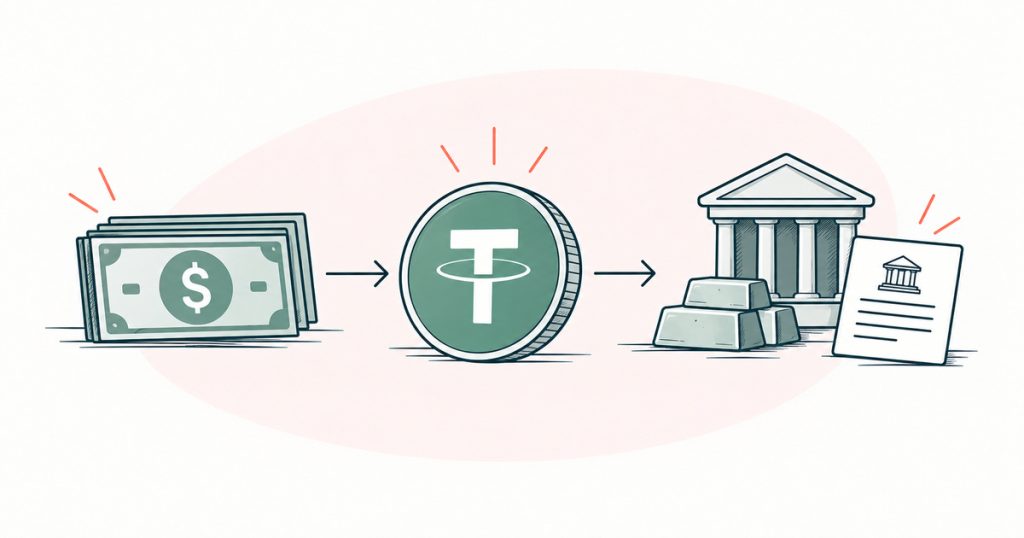
How it works
USDT (Tether) is the most widespread stablecoin. A stablecoin is a cryptocurrency whose job is not to rise or fall but to hold one and the same price, usually exactly one dollar (what that even is — in what is a stablecoin). Put simply, a “dollar in your phone”: handy for moving money and for holding it in dollars without opening a dollar account at a bank.
USDT appeared in 2014 under the Tether brand. Its issuer is the company Tether International, S.A. de C.V., registered in El Salvador; on the company and the group itself — in the Tether profile. Because of its size, USDT is often the first thing a beginner runs into on an exchange.
1 USDT is roughly equal to one US dollar, and behind the token stand the company’s reserves — the real money and assets it uses to back that price1. The backing is fiat: ordinary money stands behind the tokens — cash and safe short-term US government bonds. The exact composition and amounts change, so check the current figures there too — where to check: Tether’s transparency page.
USDT has no hard cap. Tether creates new tokens when it receives money as backing and burns them on redemption, so the amount in circulation rises and falls with demand, and for USDT it is the largest of any stablecoin. How much is issued right now can be checked in where to check: Tether’s transparency page. How coin issuance works in general is covered in the article issuance.
Reserves are checked in two different ways, and it’s important not to confuse them.
An attestation is when an independent firm confirms that on a given date the reserves were in place: in essence a snapshot at a moment, not continuous oversight. A full audit is deeper and stricter. Tether has long published attestations, and in August 2026 it reported that for the first time it had passed a full independent audit of its 2025 accounts: the firm KPMG issued an unqualified opinion2. How an attestation differs from a full audit — in what are reserves, and the current status — where to check: Tether’s transparency page.
USDT exists on several networks at once (Ethereum, Tron, Solana, and others). When transferring, it is critical that the network matches on the sender’s and the recipient’s sides, otherwise the money may not show up (see how to send crypto).
One more thing worth knowing in advance: even large stablecoins have briefly broken away from the dollar in moments of panic — this is called a depeg. How it happens, and how a temporary case differs from a fatal one — in depeg.
Where to check current USDT data
- The composition and amount of reserves, the audit and attestation status, the full list of networks — where to check: Tether’s transparency page.
- Price and market cap.
Properties
- Transfers, including cross-border ones
- Storing value in a dollar equivalent
- Settlements
A stablecoin’s reliability is, in essence, the quality and honesty of its reserves, so look first at transparency (see what are reserves).
A break from the dollar (a depeg) is possible even for a large coin (depeg). And remember: a company stands behind USDT, so it can technically freeze funds at a particular address — with fiat stablecoins the control lies with the issuing company.