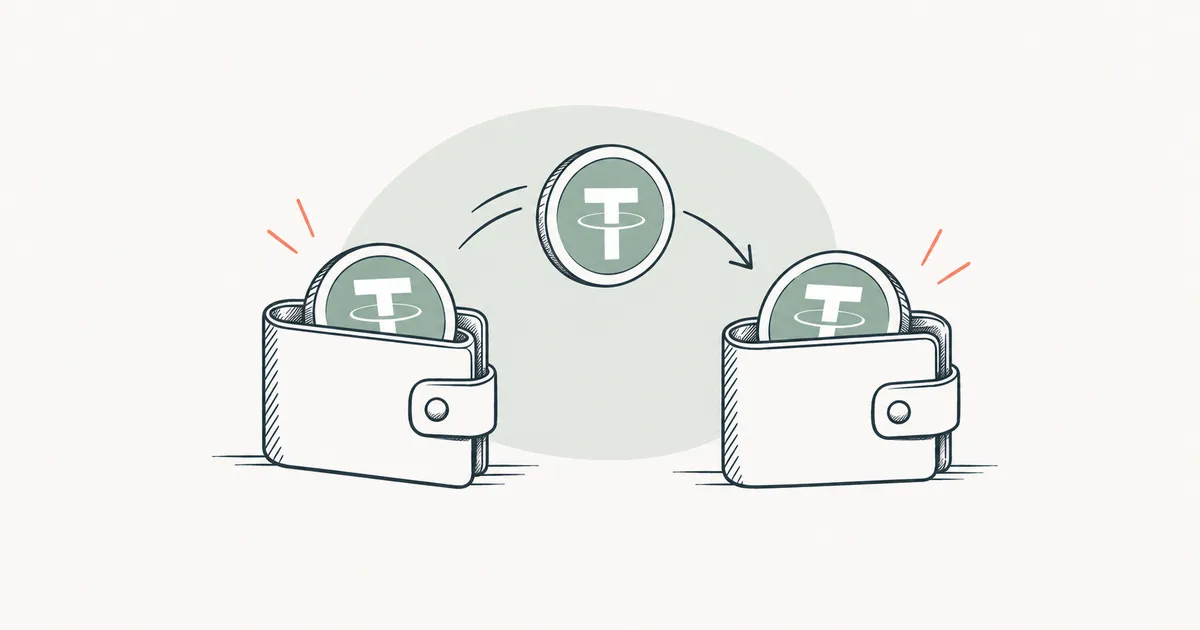
What a token standard is, and why "USDT ERC-20" and "USDT TRC-20" are different networks
A token standard in plain words
A token's records are kept by a smart contract, a program inside the network that carries out set rules on its own. A token standard token standard describes which actions this program must be able to perform and what they are called, for example showing an address's balance and transferring tokens1. Tokens themselves are covered in what is a token.
Think of a USB-C port. Phones are made by different companies, yet the port is the same on all of them, so any cable fits any phone. A token standard works the same way. If a token follows ERC-20, a wallet or an exchange will show its balance and send it in the same way as any other ERC-20 token, and nobody has to teach them each new token separately.
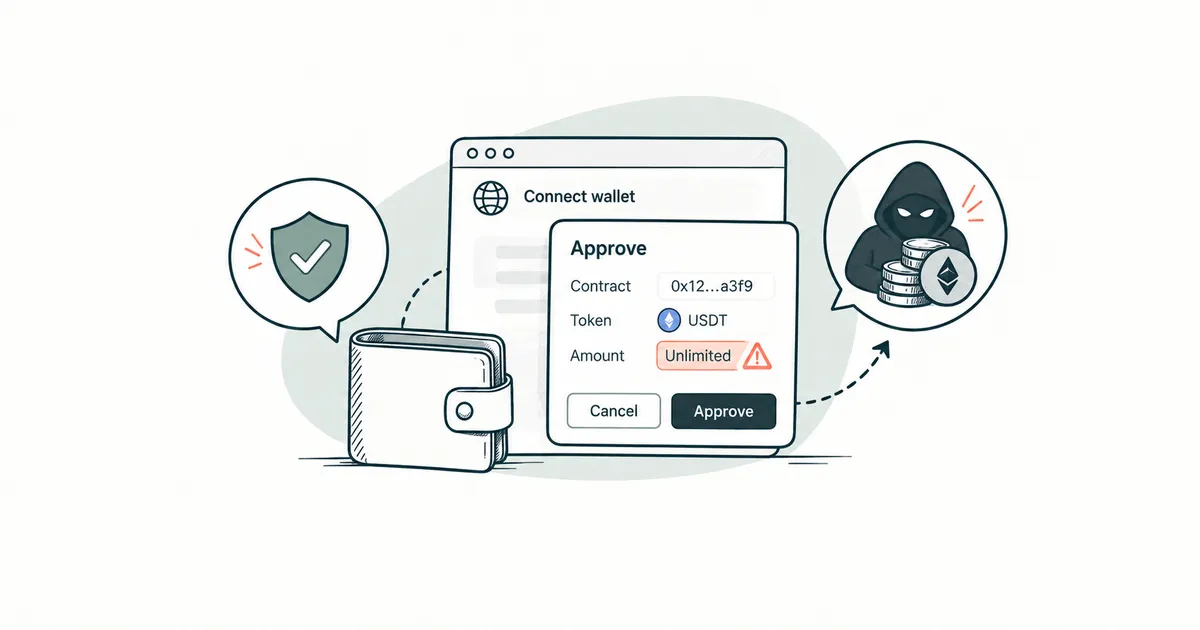
The ERC-20 standard lets an owner allow another smart contract to spend part of their tokens. In a wallet this looks like an "Allow" button on a service's website, and a fraudulent website can use such a permission to take your tokens; wallet connection safety explains this.
A standard describes only how a token is built. Any smart contract that can perform the required actions counts as an ERC-20 token2, and anyone can write one. So the words "an ERC-20 token" tell you nothing about who issued it or whether it can be trusted. How to check an unfamiliar token is explained in the same article on tokens.
Why USDT comes in different standards
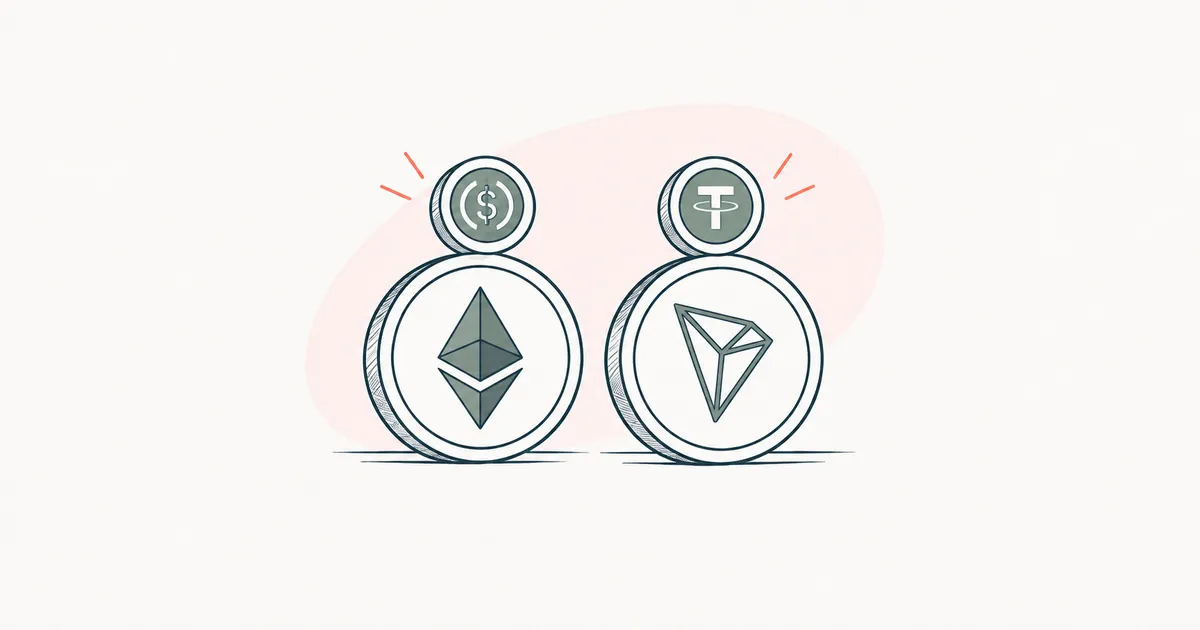
Tether issues USDT on several networks, each time under that network's standard. As of 30.10.2026, Tether's official list shows ERC20 next to Ethereum and TRC20 next to Tron, and also includes Solana, TON and other networks3. Exchanges often label the network choice with the name of the standard, so "USDT ERC-20" means USDT on Ethereum, and "USDT TRC-20" means USDT on Tron. How releases of one token on different networks are organized is covered in the article on tokens.
The USDT that exchanges offer on BNB Chain under the BEP-20 standard is not officially issued by Tether, and it does not appear on Tether's list3.
Who issues that USDT and what it means for a holder is explained in the USDT profile.
Which standard to choose when sending
When sending, you choose the standard according to the recipient. A cheaper network matters only if the recipient accepts the token on several networks. Decide in this order:
- Find out which network the recipient wants the token on. An exchange states this on its deposit page; a person you simply ask.
- Check that your exchange or wallet can send the token on that network, and that the issuer, the company that releases the token, issues it on that network at all. where to check: the list of networks on the token issuer's website, for USDT tether.to/en/supported-protocols
- If you are sending from your own wallet, keep a little of that network's coin in it for the fee.
- If several networks fit, compare the fee that the exchange or wallet shows before you confirm. where to check: the fee on the exchange's withdrawal page or in the wallet's confirmation window
- Send a test amount first, and do not rush the rest until it arrives.
The guide how to send USDT goes through the same steps for USDT, with the branching cases.
How ERC-20, TRC-20, BEP-20 and SPL differ
All four standards describe fungible tokens. A fungible token fungible token is one where every unit is exactly like any other in type and in value2, just as two banknotes of the same denomination are alike. The standards differ above all in the network they work on.
TRC-20 is the same format as ERC-20, only on the Tron network4. BEP-20 is the standard of the BNB Chain network (full name BNB Smart Chain, which exchanges also label BSC), and it extends ERC-205. The token standard of Solana is called SPL6.
A token standard, its network and the coin for the fee
| Standard | Network | Coin for the fee |
|---|---|---|
| ERC-20 | Ethereum | ETH |
| BEP-20 | BNB Chain | BNB |
| TRC-20 | Tron | TRX |
| SPL | Solana | SOL |
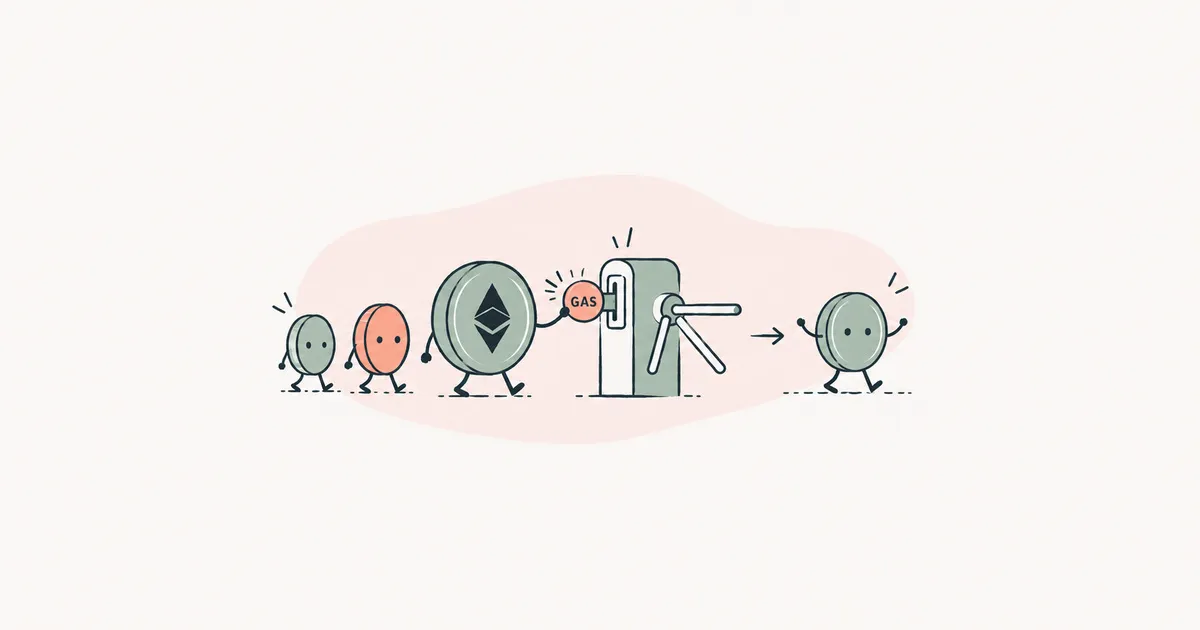
On Ethereum the fee is paid in ETH7, on BNB Chain in BNB8, and on Solana in SOL9. On Tron a transfer uses up network resources, and if there are not enough of them, the network burns TRX10. Why a token usually cannot be sent without the network coin, and which methods and apps help you lower the fee or pay it in the token itself, is explained in what is gas.
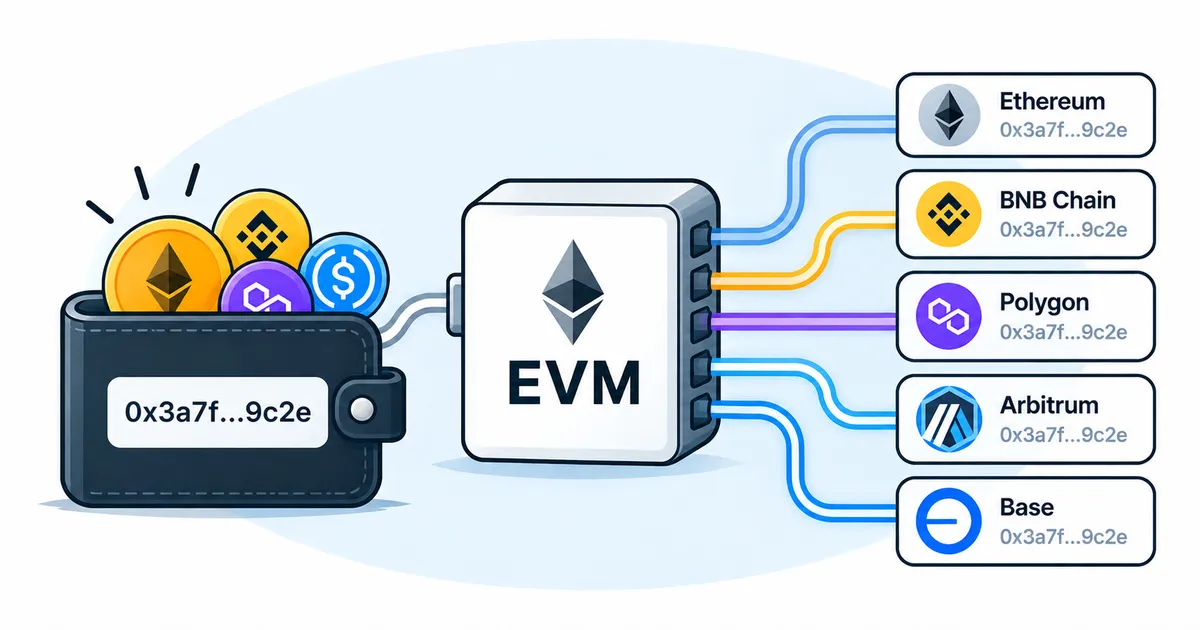
Networks compatible with Ethereum, such as Polygon PoS, Arbitrum and Base, accept the same smart contracts as Ethereum11, and tokens on them are issued under the same rules. Your "0x…" address, the number of your "account" on the network, is identical on Ethereum, BNB Chain and these networks, so the transfer form usually will not notice a wrong choice of network. Why this happens and what to do after such a mistake is explained in what is EVM.
Standards for NFTs
For unique tokens, each with its own number, there are other formats: ERC-721 and ERC-1155. NFTs are issued under them12, and NFTs themselves are covered in what is an NFT.
Can an ERC-1155 NFT be sent to an ordinary wallet?
Yes. An ordinary wallet is an address controlled by whoever holds the key, and the ERC-1155 standard applies no special recipient check to such an address13. The difficulty can be with displaying it. MetaMask, for example, lets you add ERC-721 and ERC-1155 NFTs and warns that not all NFTs display correctly14. On 30.10.2026 the MetaMask app allowed sending only ERC-721 NFTs14.
So before sending, ask the recipient whether their wallet shows ERC-1155 NFTs on the right network. Send an NFT to an exchange's deposit address only if the exchange says plainly that it accepts such NFTs.
More detail on how ERC-20 works and on NFT standards
The ERC-20 standard requires a token to report how many units have been issued, show an address's balance, transfer tokens and give another smart contract the right to spend part of the owner's tokens. A name, a ticker (a short name such as USDT) and the number of decimal places are optional under this standard1. ERC stands for Ethereum Request for Comments, the name Ethereum uses for proposals that set standards for applications15, and the number 20 is the proposal's number. ERC-20 was proposed by Fabian Vogelsteller and Vitalik Buterin on 19 November 20151.
The ERC-721 standard was created on 24 January 201812. Some NFTs are older than the standard. The authors of ERC-721 gave CryptoPunks as an example12, and the punks have their own smart contract from 2017, which came before ERC-72112. ERC-1155 was created on 17 June 2018. A single ERC-1155 smart contract can manage any number of token types, fungible and unique alike, and move several types with a single operation. Under ERC-20 and ERC-721, each token type or each collection needs a separate smart contract. The authors of ERC-1155 explained its arrival with games, where developers create thousands of item types13.
| ERC-20 | ERC-721 | ERC-1155 | |
|---|---|---|---|
| Are all units identical? | yes | no | varies |
| Several token types in one smart contract? | no | no | yes |
| Several types in one operation? | no | no | yes |
| Does a transfer check that the smart contract will accept it? | no | varies1 | yes |
- Only with the "safe" transfer, which the standard describes separately from the ordinary one. ↩
The recipient check exists for transfers to a smart contract's address. ERC-20 tokens sent to a smart contract that cannot handle them may be lost forever2. An ERC-1155 transfer in that situation is reverted13, and the "safe" transfer of ERC-721 works the same way12.