


Stablecoins in high inflation: how to reduce dependence on your local currency
In plain words
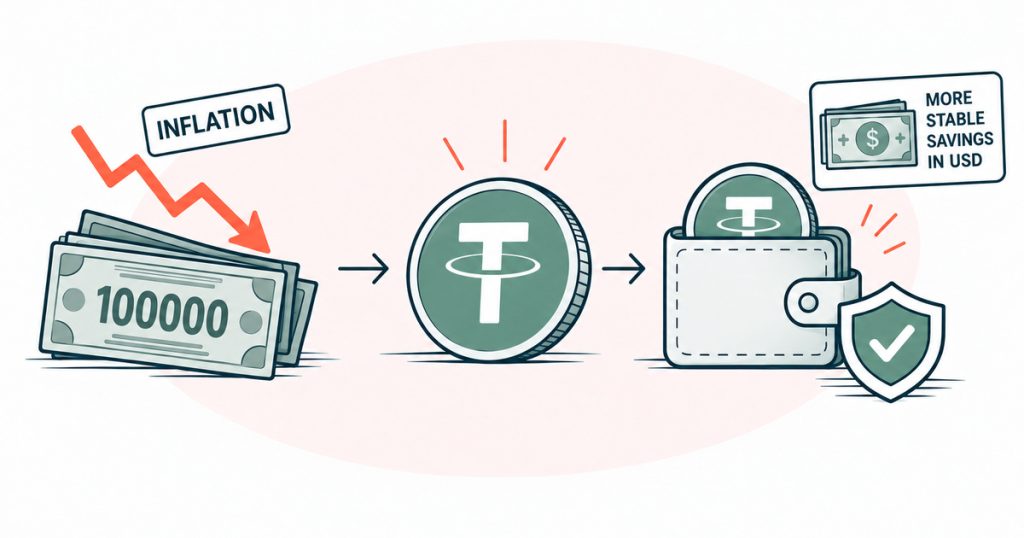
A dollar stablecoin can give you dollar exposure and thereby reduce how much your savings depend on the local currency’s rate. But it is not a dollar bank deposit and not a guarantee that purchasing power is preserved. The outcome depends on how well the peg holds, the issuer, the reserves, redemption terms, the network you choose, how you store it, fees, taxes, and your ability to convert the token back into money. The order is simple — buy the stablecoin → move it to your own wallet → store it safely — but here the risks matter more than the convenience, and they’re laid out honestly below.
Deeper
Why a stablecoin, and when it fits
Ordinary crypto swings sharply in price, while a stablecoin aims to hold one reference — usually the dollar (what it is and how it works — what is a stablecoin). For someone whose local currency is losing value, it’s a way to tie part of their savings to the dollar without opening a currency account at a bank. The word “aims” is the key one: it does not guarantee the peg.
It fits if the goal is to reduce dependence on the local currency, not to earn: a stablecoin on its own produces no income; it only holds a dollar reference. The most common are USDT and USDC; they have different issuers and different reserve transparency.
How to do it
- Buy the stablecoin. Through an ordinary exchange with a card, or P2P — the general order is in how to buy crypto. Choose the network deliberately from the start (see the risks below).
- Decide where to store it, and move it if needed. Keeping a large amount on an exchange for a long time means trusting the venue with control. Your own wallet gives you control of the keys, but shifts to you the responsibility for backups and transfers. How to set up a wallet and compare options — how to store crypto.
- Store it safely. In a classic wallet, recovery rests on the seed phrase (what is a seed phrase) — never show it to anyone; other models may use different access methods. For long-term holding, choose a model whose risks you understand.
Honestly about the risks
- This is not an “interest-bearing deposit.” A stablecoin only holds a dollar reference; on its own it produces no income, and promises of “yield on stablecoins” are a separate risk, not part of storage.
- The peg can break. Even large stablecoins have gone through a short-lived separation from the dollar — what that is, and how a temporary case differs from a fatal one, is in what is a depeg.
- Reliability is not only reserves. Reserves matter (what are reserves), but so do the holder’s legal rights, the order and possibility of redemption, liquidity, the custodian bank, and the issuer’s operational resilience.
- Behind a fiat stablecoin is a company that can technically block an address or freeze funds in the cases its rules and the law provide for. That’s a different set of risks than a bank, not an “absence of risk.”
- The dollar’s rate against your currency also changes, and the dollar itself is subject to inflation — a stablecoin reduces dependence on the local currency, but it does not make the sum “bigger” and does not guarantee purchasing power.
- Storage is not “automatically safer” in a cold wallet. A hardware wallet reduces the risk of remote key theft, but it does not protect against a depeg, an issuer freeze, a wrong address or network, or a lost backup. Self-custody swaps venue risk for the risk of managing keys yourself.
- Taxes and cashing out. Buying, exchanging and cashing out depend on the regulated services available and your country’s rules; selling or exchanging may have tax consequences — how to handle crypto taxes.
- Scams target newcomers right at the entry point (fake sites, a “great rate”) — phishing and scams.