


Services
› DEX › Uniswap
Choosing an exchange
Uniswap
DEX · Decentralized exchange (DEX)
The largest decentralized exchange: swaps straight from your own wallet via a smart contract. No one holds your funds — which changes both upsides and risks.
✓ Verified 24 Aug 2026
How it works
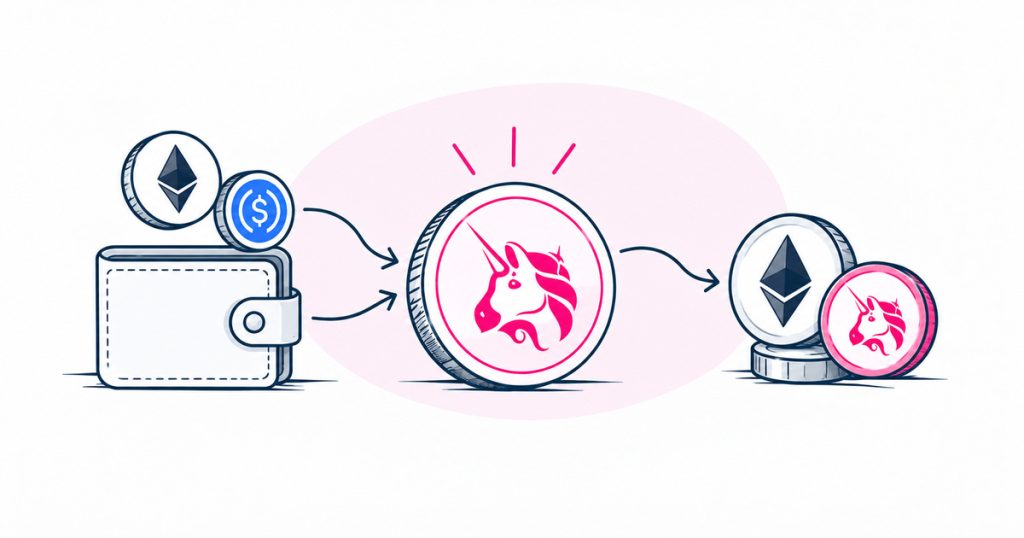
Uniswap is the largest decentralized exchange (DEX): swapping coins straight from your own wallet, without an intermediary company and without registration. Unlike an ordinary exchange like Binance, here no one holds your funds — you swap by interacting with a smart contract, not with a company. This changes both the upsides and the risks.
- Type — DEX. Trades are matched not by a company but by a smart contract. It works on the “automated market maker” model: instead of an order book — shared liquidity pools, out of which you swap one thing for another.1
- “Uniswap” is layers, not one whole. There is the protocol (open smart contracts anyone can use), and on top — the Uniswap Labs interface (the official app) and a wallet, plus third-party interfaces. Buying with fiat goes through third-party providers, which may have their own KYC. So “no registration” is about the protocol itself; a specific interface or on-ramp may have its own conditions.
- Control — yours. The coins do not sit “on the exchange”: you connect your wallet and swap straight from it. There is no separate “withdrawal” — the funds are already yours.
- KYC and registration — none for the protocol: no account is needed, only a wallet. But a fiat on-ramp in the interface may require verification.
- Networks — Ethereum and others; for operations you pay gas (see what is gas).
- The UNI token — a governance token: it gives a vote in decisions about the protocol (see what is a token), not a share or “stock”.
Who it suits, who it does not
- Suits: those who want a swap without an intermediary, already have a wallet, and understand what approve is (see wallet connection safety).
- Suits less: a complete beginner for a first purchase — an exchange with a card is simpler (see how to buy crypto); and those not ready to answer for signatures and addresses themselves.
Fees
1
Pool/protocol fee
Built into the trade, depends on the pair. By a governance decision ("UNIfication", late 2025) protocol fees were activated — part of the pool fee goes to the protocol; the specific rates change.
2
Interface fee
The official Uniswap Labs app charges its own fee for a swap — separate from the pool fee; other interfaces may not have it.
3
Network gas
Separate; can be noticeable on Ethereum at rush hour.
4
Slippage
The price may change slightly between the click and execution — a permitted limit is set.
Security
i
No intermediary — no support that will reverse a transfer
Trades are irreversible, the responsibility is on you.
!
The main beginner risk — a dangerous approve
When connecting a wallet and granting a contract access to coins, understand what you are signing (see phishing and scams).
i
Look-alike tokens
On a DEX you can swap anything, including fake tokens with a similar name — check the contract address.
i
Different interfaces — different conditions
The official app and a third-party interface may have their own fees and rules; check which interface you are using.
How to judge for yourself
- The openness of the code and audits.
- Whether the contract/site address is the original.
- Whether a reasonable slippage is set.
- What fees the specific interface you use charges.
Compare with others
Back to the choice: objective slices and why there is no "best overall".
Sources
Every fact-flag is verified separately. We don't publish changing rates — we link to "where to check".
1
AMM model: liquidity pools instead of an order book Uniswap — How Uniswap Works · archive ↩ Verified 18 August 2026 · primary source