


EURC (Circle) — a euro stablecoin
How it works
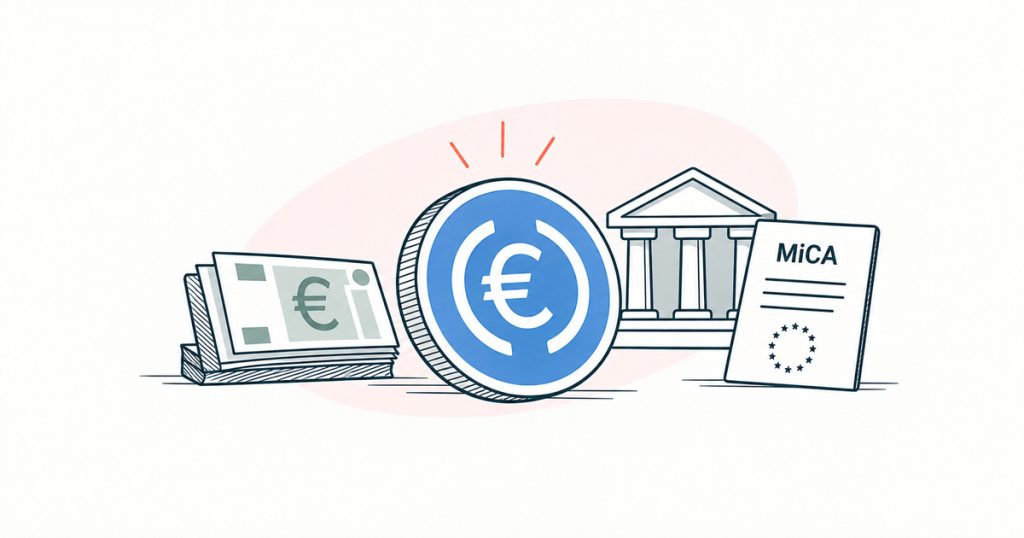
EURC is a stablecoin pegged to the euro, not the dollar. A stablecoin is a cryptocurrency that holds one price; here the reference point is the euro. EURC is issued by the same company, Circle, that issues USDC, and on the same logic: behind each token stands roughly one euro in reserves, one to one. The only difference from most stablecoins is the reference point: the euro rather than the dollar (the shared mechanics are covered in what is a stablecoin). It comes in handy if settlements and savings in euros are closer to you.
One EURC is backed by roughly one euro (one to one), and behind it stand euro assets that Circle holds in regulated financial institutions in Europe1. You can exchange EURC back into euros with the company itself under its terms and holder requirements, and not everyone has the same access; usually, though, the token is simply sold on the market. EURC has no separate technical document (whitepaper), just as USDC has none: Circle discloses how it works and its reserves on its own pages, not in a whitepaper.
Behind EURC, as behind any stablecoin backed by ordinary money, stands the company Circle, and it can technically freeze funds at a particular address. This is a different set of risks than stablecoins on crypto collateral (DAI). Exactly who issues the token and on what terms depends on the country: EURC is aimed at the EU/EEA and the MiCA rules.
EURC has no hard cap. Circle creates new tokens when it receives euros as backing and burns them on redemption, so the amount in circulation moves with demand, and it is noticeably smaller than that of the dollar USDC. How much is issued right now can be checked in where to check: Circle’s page. How coin issuance works in general is covered in the article issuance.
Every month Circle publishes a reserve check: confirmation as of a date that the euro assets are no less than the tokens issued1. Such a check as of a date is called an attestation: a snapshot at a moment, not continuous oversight; how it differs from a full audit is explained in what are reserves.
EURC exists on several networks at once (Ethereum, Solana, and others). When transferring, choose the same network on both sides, otherwise the money may not show up (see how to send crypto).
Circle states that EURC meets the European MiCA rules and that the company is obtaining the necessary licenses in the EU. Regulatory statuses change over time, so the current one is best checked directly: where to check: Circle’s page and the regulator’s site.
Since EURC is pegged to the euro, its price in dollars moves with the euro-to-dollar rate. This is not a break from the peg but simply a different reference point: against the euro the coin holds one to one, while against the dollar it “floats” exactly as much as the euro itself moves.
Where to check current EURC data
Reserve composition and amount, the check reports, the regulatory status, redemption terms, and the list of networks: where to check: Circle’s page. Price and market cap:.
Properties
- Transfers and storing value in a euro equivalent
- Settlements where the euro rather than the dollar is the reference
Reliability rests on the quality of the euro reserves and on whether they are confirmed honestly (see what are reserves). A company stands behind the token, one that can technically freeze funds, and it also sets the redemption terms.
A break from the reference (a depeg) is possible here too (depeg). And keep the currency nuance in mind: a swing in EURC’s price in dollars is the euro itself moving, not the peg breaking.