


Solana (SOL) — a fast, cheap network
How it works
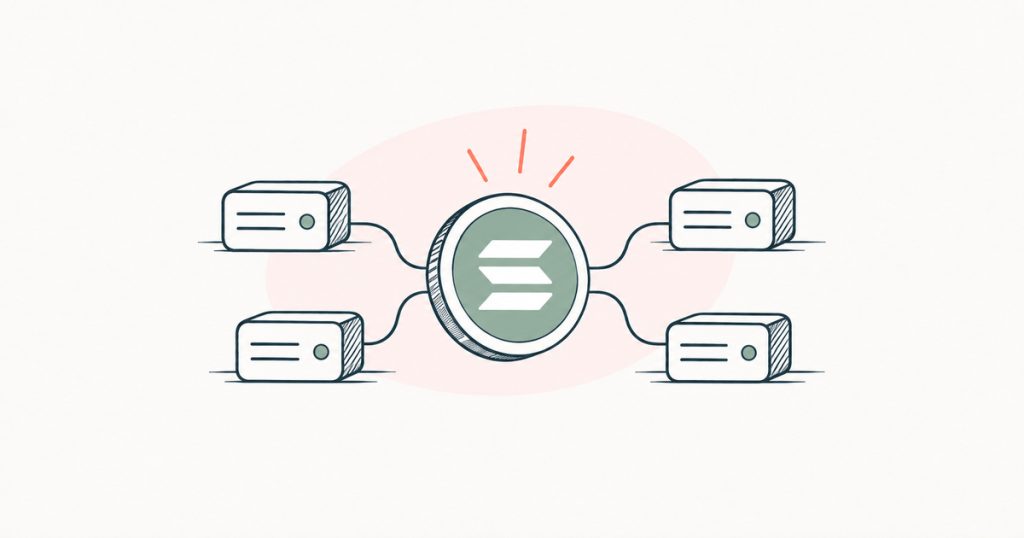
Solana is a network for smart contracts (smart programs), built with an eye toward high speed and low fees; for its range of apps it is often compared with Ethereum. Its distinctive feature is the Proof of History mechanism: put very simply, this is the network’s built-in “clock,” which helps participants quickly agree on the order of operations. Because of that speed and low cost, Solana has many tokens, NFTs, and apps. SOL is the coin of this network: you pay the fee for operations with it, and you can put it up as a deposit (stake it) in favor of those who keep the network running.
The network is secured by a deposit of coins — the Proof of Stake method, “proof of a stake” (Solana’s variant of it is called Tower BFT). Meanwhile Proof of History is not a separate way of securing the network but precisely a “clock”: it lines events up in time so that participants find it easier to agree on the order of operations. Who keeps the network running — miners and validators; the general principle — what is consensus. The network itself went live on 16 March 2020, and the project was begun in 2018 by Anatoly Yakovenko and Raj Gokal1. Solana’s architecture and the idea of Proof of History were described by Anatoly Yakovenko in the technical document (whitepaper)2.
Solana was designed to be fast and cheap. It adds records very often: in August 2026 the target step was reduced from 400 to 350 milliseconds, and this parameter changes, so the current value — where to check: Solana Changelog and active feature gates. The network burns part of the fee for an operation, that is, removes those coins from circulation forever, while the priority surcharge goes to whoever assembles the block. New coins also appear on a schedule, which is called issuance: on the plan stated as of the review date they are first added at a pace of about 8% a year, from there the pace drops roughly 15% each year until it approaches about 1.5% a year, and the current actual value2.
SOL can be put up as a deposit to a validator, which is called staking, and earn a reward whose size changes, and the current staking yield. There is no automated penalty for cheating, that is slashing where part of the deposit is burned, inside the network as of the review date. A distinctive Solana feature is a small refundable deposit: to store your account’s data the network asks you to freeze a small amount, and this is not a recurring fee — it is returned when the account is closed. Beginners are often alarmed by it when first receiving a token, though there is nothing to lose here. Tokens on Solana follow the SPL Token and Token-2022 standards — this is like ERC-20 on Ethereum (see what is a token).
As for reliability, to be honest: Solana has had major halts in the past — about 17 hours on 14 September 2021; in 2022 three halts (about 7 hours on 30 April, about 4.5 hours on 1 June, 6 hours 19 minutes on 30 September); on 25–26 February 2023 about 19 hours 42 minutes in a degraded mode before a manual restart; about 5 hours on 6 February 2024. The official incident feed, checked on 25 August 2026, shows no later full halts, but this is an observation as of a date, not a promise that there will be no failures2. Resilience is also helped by the network running on two independent client programs (Agave and Firedancer): when there are several, the network is sturdier, and their current shares change.
There are also exchange-traded funds for Solana, called ETFs: through such a fund you can get exposure to the price of SOL from an ordinary brokerage account, without buying the coin itself. The Canadian 3iQ Solana Staking ETF (SOLQ) began trading on the TSX on 16 April 2025 and lets you get exposure to the price of SOL including staking. In the US the set of such products changes.
Where to check current Solana data
- Price, market capitalization, circulating and total supply.
- Real TPS and average fees — where to check: Solana Explorer or an analytics dashboard with a measurement date.
- Validator count, stake share, staking yield, and Nakamoto coefficient.
- The status of spot SOL ETFs in the US.
Properties
- Payments and settlement where high speed and low fees matter
- Running applications, tokens, and NFTs
- Staking
SOL is not a stable coin: its price can rise and fall sharply. The working of transfers and apps, moreover, depends on the state of the network, and Solana has had prolonged halts in the past — worth keeping in mind if you are planning an operation at a specific moment. As everywhere in crypto, keeping your coins safe is on you alone (what is a seed phrase, how to store crypto).