


Solana (network) — a fast platform for tokens and apps
Overview
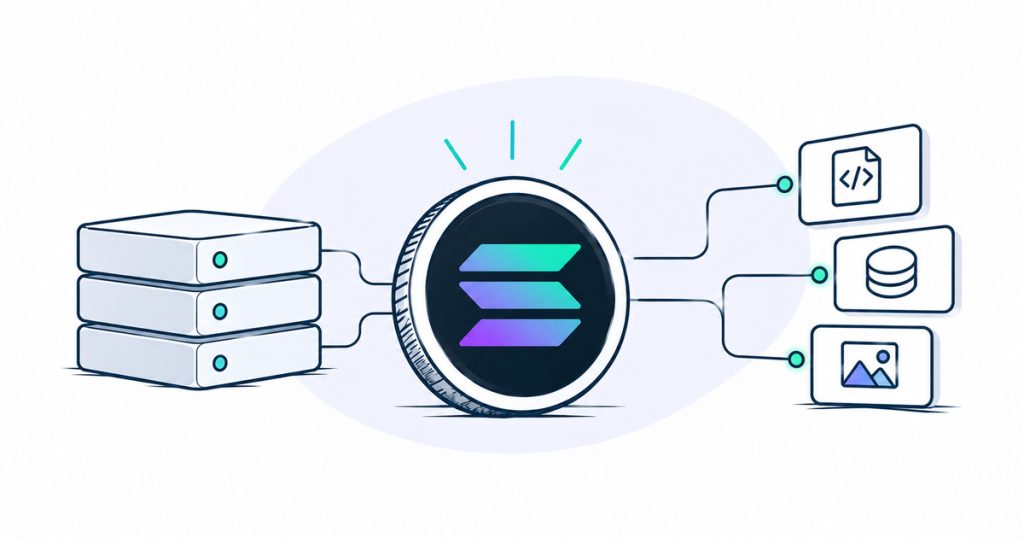
Solana is a network for smart contracts (smart programs) built with high speed and low fees in mind. Put simply, it works as a platform: tokens and NFTs are issued on top of it and apps are built inside the network. The network’s native coin is SOL, its profile is in the article Solana (SOL).
How the Solana network works
The network is secured through staked coins, a method called Proof of Stake (Solana’s variant is called Tower BFT): participants freeze their coins as a pledge of honest work (see what is consensus, miners and validators). A distinctive feature of Solana is the Proof of History mechanism, whose idea was described in the network’s technical document (whitepaper)2.
Proof of History does not secure the network by itself, it only orders events in time, like a built-in clock, so that participants can more easily agree on the order of operations. What secures the network is the staked coins (Proof of Stake, in Solana’s case Tower BFT).
Programs for Solana are written most often in the Rust language (less often in C or C++), frequently with the help of the Anchor framework, which simplifies development. A finished program (on Solana smart contracts are called just that, “programs”) is run by the network the same way for everyone. That is why all sorts of applications are built on Solana: decentralized exchanges and lending services (grouped under DeFi), NFT collections and marketplaces, meme tokens, games and payment services.
Almost anyone can issue a new token on Solana, and it is done in the common SPL Token format (and its newer version Token-2022), similar to ERC-20 on Ethereum (see what is a token). The author sets a name, a symbol and the number of coins, after which the token appears in the network’s wallets and exchanges, and you do not even need to know how to program for this, because ready-made builder services handle the launch. That is how many meme tokens appeared on Solana, for example Bonk, which was distributed to the community through a free airdrop in December 2022 and became one of the network’s best-known tokens3.
The network also has a couple of practical details. To store account data, the network asks you to freeze a small amount, this is not a recurring fee, it is returned when the account is closed. The network also runs on two independent client programs (Agave and Firedancer), and the more of them there are, the more resilient it is.
Solana is the network-platform itself, while SOL is its coin, used to pay for operations and put up as a stake. When people say “I bought Solana” they usually mean the coin SOL (its profile is in the article Solana (SOL)).
Solana network reliability: what happened
The Solana network has halted several times in the past, and this is a notable part of its history. The major failures fell mainly in the 2021–2023 years, when the network stopped working several times, in September 2021 it was offline for about 17 hours, and in February 2023 it had to be restarted manually. The last full halt in the official feed dates to 6 February 2024 and lasted about 5 hours. The official feed shows no later full halts as of 25 August 2026, but this is an observation as of that date, not a promise that there will be no outages2.
Solana, unlike the oldest networks, has fully halted several times, the last time in February 2024. Updates and a second client program make it more resilient, but do not by themselves rule out future outages. Check the current status in where to check: status.solana.com.
Current Solana network metrics
The real speed and average fee, the number of validators and the share of stake, the target network step and the client-program shares all change constantly, so check the latest in where to check: Solana Explorer, a network health report and the Solana Changelog.
Assets of the network
Assembled automatically: all asset records whose asset_network = Solana (SOL, as well as tokens, stablecoins and NFTs of this network).
— Editor note (not published): EN mirror of Хаб_сеть_Solana_RU — synchronous. Blockchain profile (hub assembly point). Hybrid + callouts [!note]/[!warning] (2026-09-18). H1 “Solana (network) — a fast platform for tokens and apps”. Solana whitepaper (Proof of History) as primary; archive — TODO at seeding. Owner-requested: program language (Rust/C/Anchor) + app types (DeFi/NFT/meme tokens/games) + a paragraph on issuing a token on Solana with the Bonk example (Dec 2022 airdrop). All facts/numbers/dates preserved (400→350 ms, 2021–2024 halts, 06.02.2024 ~5h); changing numbers →. Guardrails: PoH = clock (not consensus); consensus = PoS (Tower BFT); no reliability absolutes. Hub slug: solana-network.