


Who are miners and validators in a blockchain?
In plain words
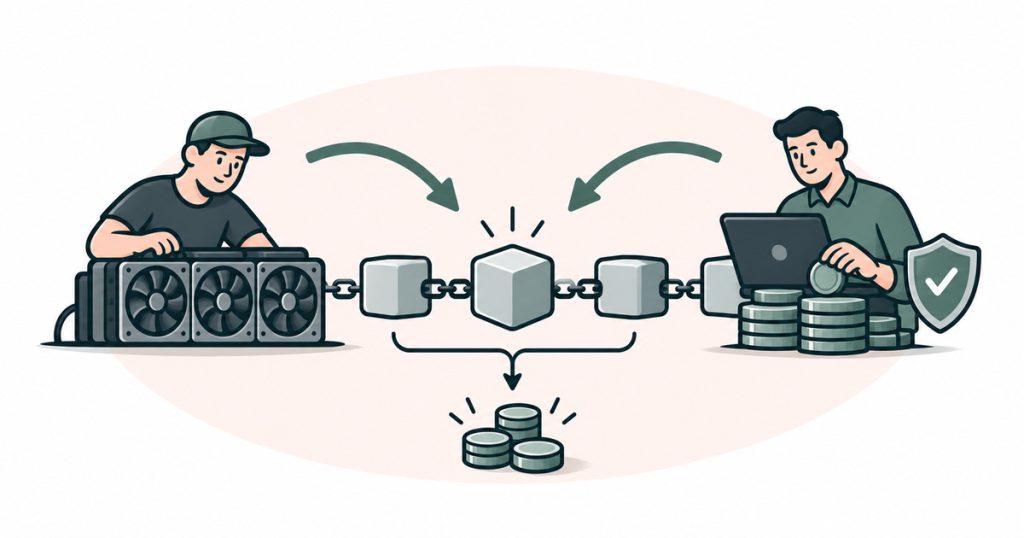
Miners and validators are the people who keep a blockchain running and take turns adding new blocks to it. A block is a single record of a whole batch of transfers, which the network adds to the shared history of operations. Whether such a participant is a miner or a validator depends on the rules of the particular blockchain. How the network agrees on new blocks is set by the blockchain’s developers and written right into its code. This set of rules is called the consensus mechanism, and it is explained in detail in what is consensus. Usually the mechanism stays the same for the whole life of the network, because it is baked into the code. But sometimes it is changed. Ethereum, for example, switched over time from proof of work to proof of stake.
Miners are found in networks like Bitcoin. There the right to add a block has to be earned by a computer’s work, and this method is called Proof of Work. A miner spends their computer’s power and electricity to be the first to solve a hard computational puzzle. Whoever solves it first adds the new block and gets a reward in coins for it.
Validators are found in networks like Ethereum. There the right to add a block comes from a deposit, and this method is called Proof of Stake. A validator does not spend computing power. Instead they freeze part of their own coins in that network as a deposit, a promise to act honestly. While the deposit is frozen, the network’s rules give them a turn now and then to put the next block together, and other validators check their work.
Put simply, miners are like prospectors who spend effort and equipment for a find, while validators are like part-owners who have put their own money into the shared venture and lose it if they cheat, so being honest pays off for them.
Deeper
Miners and proof of work
A miner solves a hard computational puzzle. It cannot be worked out by reasoning or a formula. You can only try one variant after another, and that needs powerful computers and a lot of electricity. Whoever finds the answer first adds the next block. The network’s new coins appear right in that new block and go to the miner as a reward. The more computing power a miner has, the higher their chance of being first, which is why large miners fill whole halls with equipment and why networks built this way use so much energy. How new coins appear in a network is covered in what is cryptocurrency.
Validators and proof of stake
A validator is whoever has frozen a deposit, their own coins in that same network. Only these coins can be put up, not property and not money from outside. The deposit alone does not give the right to build every block. Who builds the next one is decided by the network’s rules, in turn and largely at random. The bigger the deposit, the more often that validator is chosen on average. The chosen validator gathers new transfers into a block and offers it to the others, who check that every transfer in the block is genuine. For honest work a validator earns a reward. If they try to cheat, part of their deposit is burned under the network’s rules. Cheating can mean, for example, trying to push through a fake transfer or approving two conflicting versions of the network’s history at once. This penalty is called slashing, and it does not exist in every proof-of-stake network. Such networks usually need far less energy than ones where coins are mined.
Keeping a network running is not always the same as earning
A reward for a new block is not paid in every network. On XRP, for example, the whole supply was issued at launch, there is no mining at all, and validators run their servers for the network’s reliability rather than for earnings1. The takeaway for a beginner is simple. Keeping a network running and earning from it are not the same thing. And how new coins actually appear in a given network is best checked in that coin’s own profile.
Miners and validators: what this means for you
Who keeps a network running, and how, affects a lot. It shapes where the network’s new coins come from, how hard it is to attack, and how much electricity it uses.
In networks where coins are mined there is one more link worth knowing about. A miner has to cover electricity and hardware, so when the block reward stops covering these costs, large miners, who hold a lot of coins, may start selling them, and that pushes the price down. When mining is profitable, they have less reason to sell. There is no exact formula here, but the link between the cost of mining and how large holders behave is worth keeping in mind.
Becoming a miner or a validator is, in principle, open to almost anyone, and people do earn from it if they can meet the requirements: hardware and electricity for mining, and the size of the deposit plus a reliable server for a validator.
Exact numbers, such as how many validators there are or the size of the reward, change all the time. So they are not in the text, and you look up the current values in a network explorer.