


What is a blockchain?
In plain words
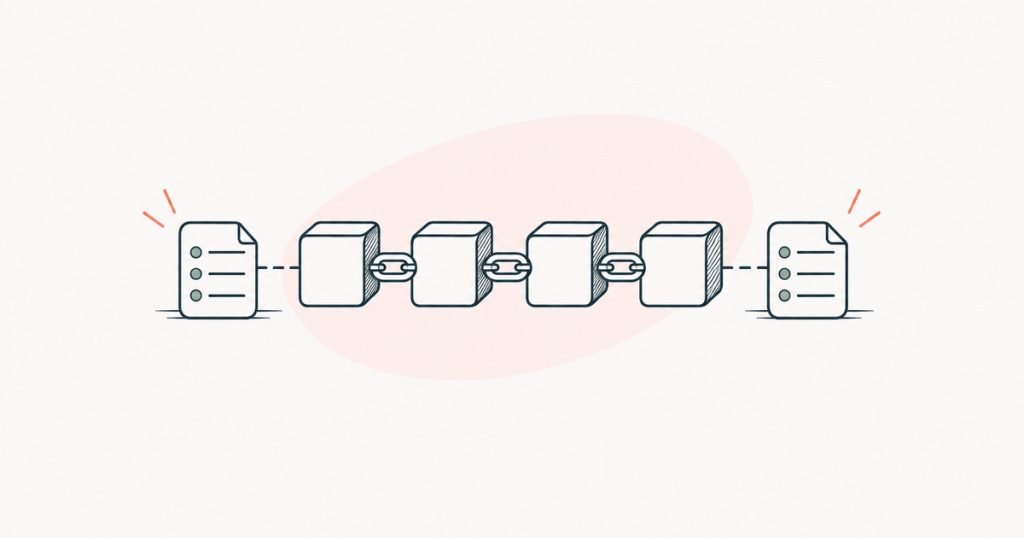
A blockchain is a shared ledger of records of who passed what to whom. It is kept not in one place, but as copies held by many participants of the network at once. New records are gathered into blocks, and the blocks are linked to one another in order, one after another. That is where the name chain of blocks comes from.
Picture a shared notebook that thousands of people each hold a copy of. Every new page refers to the previous one, so you cannot tear out or quietly rewrite an old page. Everyone else’s copy would stay as it was, and the swap would stand out at once. To forge a record you would have to rewrite it at the same time for the majority of participants. In a large network that is almost impossible. In a small network, taking control of the majority is cheaper, and there it does happen from time to time; such an attack is called a 51% attack.
The first blockchain to come into wide use was the Bitcoin network. The idea itself had earlier precursors. Later many blockchains appeared, and they are very different from one another; the article what is cryptocurrency covers this.
Why it matters to you. It is the blockchain that lets crypto work without a bank as a middleman. The record-keeping is done by the whole network at once, rather than by a single company you would have to trust.
Deeper
Why a chain, and why it is hard to rewrite
Each block stores its records along with a short fingerprint of the previous block, something like a digital imprint of its contents. Change even one thing in an old block and its fingerprint becomes different. The reference to it in the next block then stops matching, and the rest of the chain falls apart after it. The break is visible to the whole network at once. It is this interlocking that makes the history of records practically impossible to alter.
On top of this comes distribution. Many hold a copy of the ledger, and they all constantly cross-check it against one another. There is no single point whose failure would instantly stop everything. But the absence of a single center does not mean there are no weak spots at all. If most of the computing power or coins are gathered in the hands of a few participants, influence over the network comes back to them. That is why real decentralization in practice matters, not only on paper.
Who adds the blocks, and why the fee affects speed
New blocks are not added for free. The block reward is programmed into the network’s own code, so the blockchain, in effect, pays those who keep it running — miners or validators, whom the article miners and validators is about. On top of the reward, they also get the fees for the transfers that made it into the block.
From this follows something that matters to you directly. Your transfer first waits in a shared queue of unconfirmed transfers, called the mempool. Whoever builds the next block wants to earn more, so they take the highest-fee transfers from the queue. That means a higher fee gets you a faster confirmation, and a lower fee means a longer wait. How the fee itself works, and why its size jumps around, is covered in the article what is gas.
Once a transfer makes it into a block, it gets its first confirmation. Each further block on top of it is one more confirmation, and the more there are, the harder that transfer is to reverse. How many confirmations your transfer has already gathered is visible in a network explorer.
What a blockchain can and cannot do
One thing a blockchain does well. It reliably records what happened and in what order, without a trusted middleman. But on its own it does not determine which new record counts as true when participants disagree. That takes a separate agreement mechanism, which the article what is consensus covers.
A blockchain also does not make data private, and more often the opposite is true. Most blockchains are open, and any transfer in them is visible and stays there forever. This is both transparency and the reason crypto is not anonymous on its own. There are also closed blockchains that let people in only by permission, but the public crypto networks usually being talked about are open to everyone.
Figures that change, such as the number of blocks or the size of the network, are not put into the reference; you look them up in a network explorer.