Ethereum (ETH) — the smart-contract network
Ethereum in plain words
What digital money without a bank is, the article what is cryptocurrency explains.
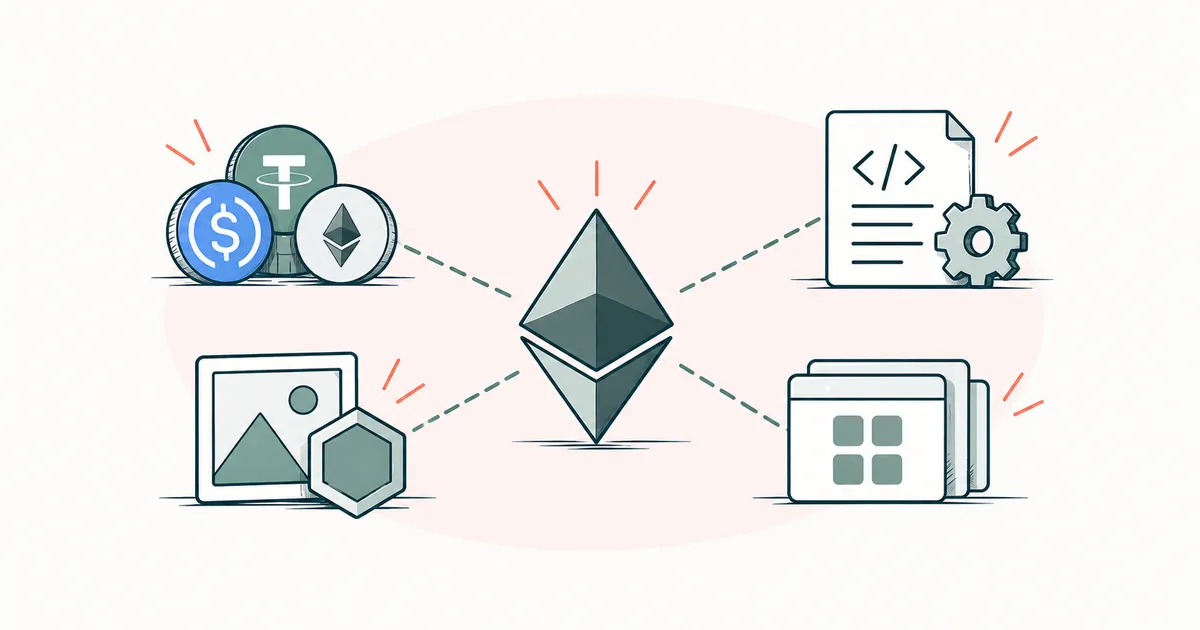
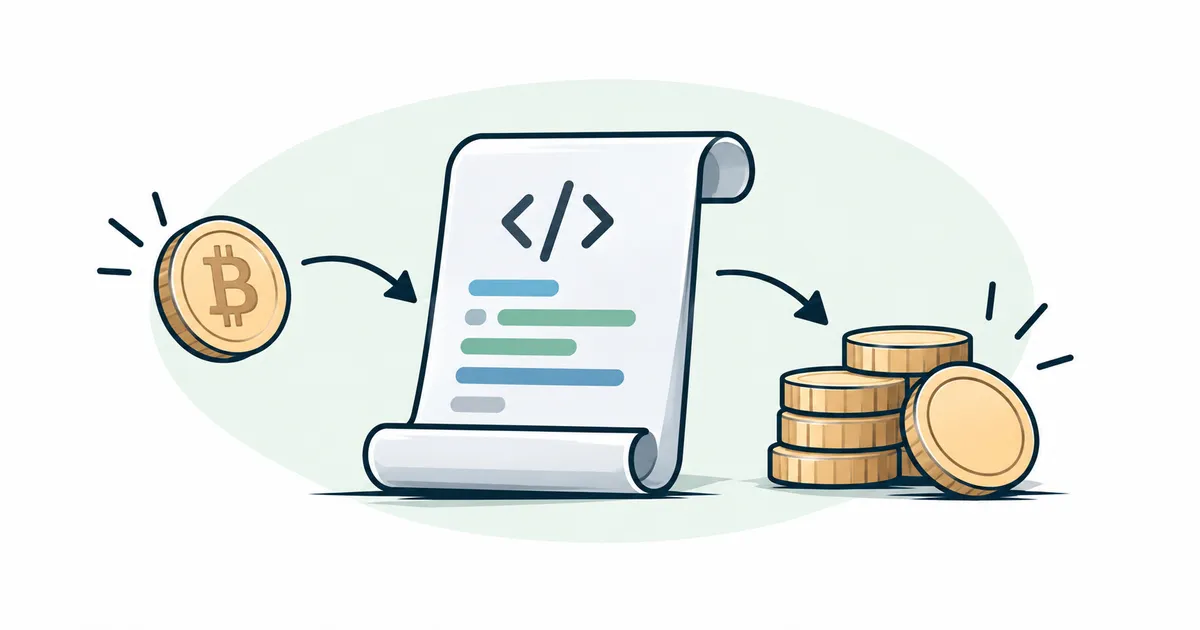
Bitcoin is like a calculator that does one job and keeps track of coins. Ethereum is more like a smartphone. It keeps track of coins too, but anyone can install their own program on the network, and that program will run the same way for every participant. These programs are smart contracts, covered in detail in smart contract. Tokens run on them, stablecoins (digital dollars on a blockchain) among them, and so do NFTs, exchanges where people swap crypto without a company in the middle, and lending services.
The network and the coin have different names. The network is Ethereum, and the coin is Ether, ETH for short. When people talk about "the price of Ethereum", they usually mean the price of the ETH coin1.
How validators agree on blocks, how the network gets upgraded and which outages it has had are covered on the page the Ethereum network.
What the ETH coin is for
The fee for operations on the Ethereum network
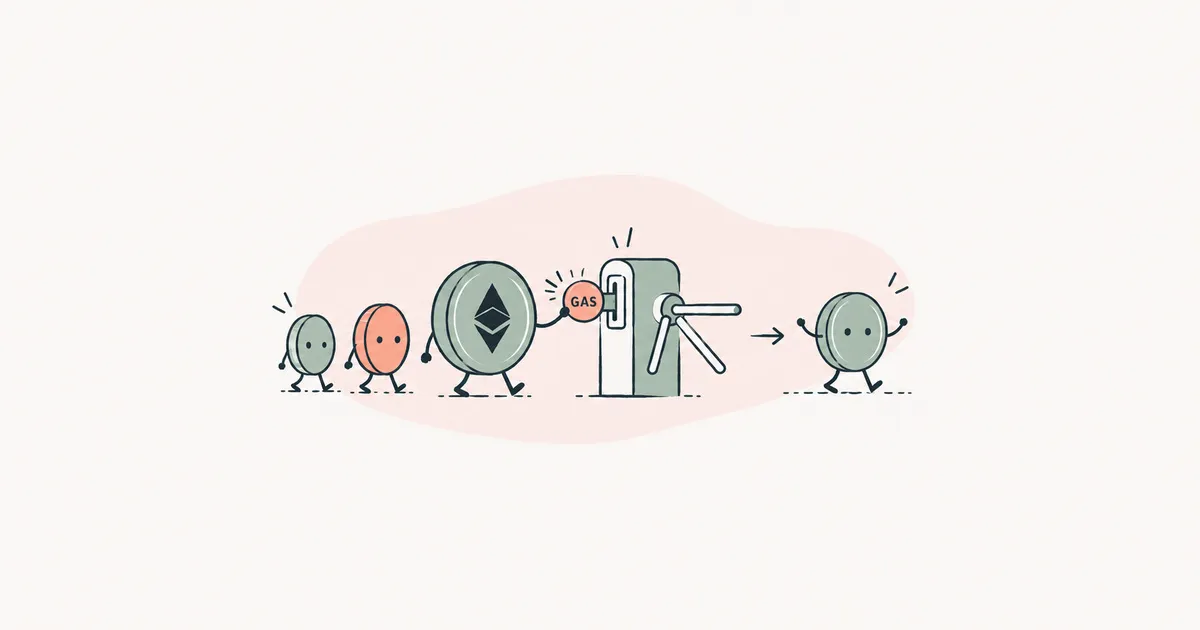
Every action on the Ethereum network costs a fee. It is called gas, and the network accepts it only in ETH2. Think of the post office: you pay for sending a parcel at the counter, and nobody takes what is inside the parcel as payment. Tokens work the same way. To send USDT or USDC on Ethereum, you usually need some ETH in the wallet. Some wallets and apps help lower the fee or let you pay it with the token you are sending, USDT for example. The fee is charged even when the operation fails2.
Wallets often show the fee in gwei, which is one billionth of an ETH2. Why gas gets more expensive at some moments and cheaper at others, and how to pay less, is explained in what is gas. For what a transfer costs right now, look at.
An Ethereum address and identical addresses on different networks
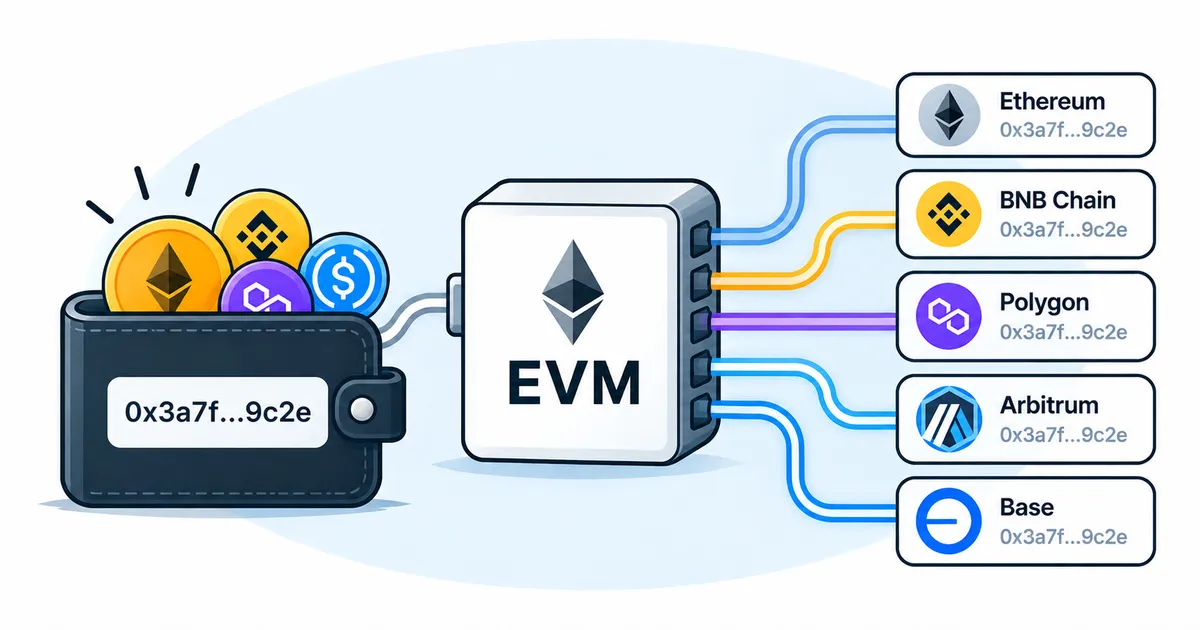
An Ethereum address is the number of your "account" on the network, where people send you crypto. It has 42 characters and starts with "0x"3. Both ETH and this network's tokens arrive at the same address. Networks compatible with Ethereum, such as BNB Chain and Polygon, use addresses that look exactly alike, so you cannot tell the network from the address, and the recipient is the one who chooses it. A transfer sent on the wrong network will not show up where the recipient expects it. The reason is explained in what is EVM, and how to send without mistakes in the guide how to send crypto.
Staking ETH for a reward
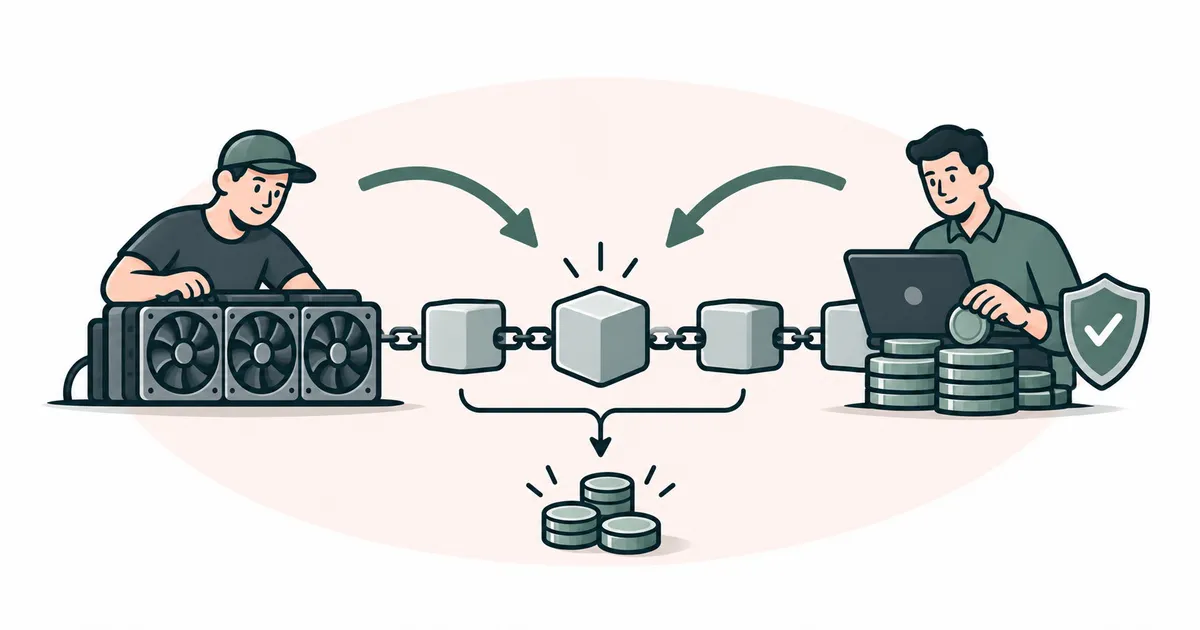
Staking means you lock up a network's coins as a deposit to back a validator, the participant who checks transfers, and in return you get part of that validator's reward.
From the outside, staking looks like a bank deposit: the coins sit there and a reward builds up. There are four differences. The reward is paid in the same coin, and its price changes. No government insures these coins. If the validator breaks the rules, on some networks part of the deposit can be taken away. And you usually cannot take the coins back right away.
To become a validator yourself on Ethereum, you need to deposit 32 ETH and run a computer that stays connected to the network all the time4. A validator receives new ETH and part of the fees, and loses part of its deposit for dishonest work. Without 32 ETH, you can hand your coins to a service, an exchange or a pool, which gathers the coins of many people into one shared deposit5. In that case the intermediary holds the coins, and its risks become yours. Taking ETH out of staking has been possible since 12 April 20236.
The risks of staking through a pool or an exchange are covered in miners and validators. The staking reward and the length of the exit queue change all the time.
ETH risks
- The price of ETH can change sharply, sometimes within a single day, so put in only an amount whose value you are ready to lose.
- A sent transfer cannot be reversed. Before sending, make sure the address and network are both right, and send a large amount only after a test transfer.
- You alone are responsible for your wallet key. If you lose your seed phrase, the set of 12 or 24 words from which a wallet restores your keys, you lose access to your ETH, and support cannot bring it back (what is a seed phrase, how to store crypto).
- A smart contract can get the right to spend your tokens if you sign a permission on an app's website. Before signing, read what exactly the wallet is asking for (wallet connection safety).
- Scammers use network upgrades as cover and come with offers to "move your coins to the new version". How to recognize such schemes is explained in phishing and scams.
How Ethereum works
How much ETH there is and where new coins come from
ETH has no cap like Bitcoin's 21 million coins. New ETH goes to validators as a reward for checking transfers, and the more ETH all validators have staked, the larger the issuance8.
At the same time, some ETH disappears, because the larger share of each fee is burned62. The busier the network, the more ETH burns, so the total amount of ETH sometimes grows and sometimes shrinks9.
Some ETH existed even before the network launched: in 2014 it was sold for bitcoins in a public sale6. Coins created before regular issuance begins are called a premine.
For the current amount of ETH and today's burn, see.
How issuance works for different cryptocurrencies is the topic of what is issuance.
Who created Ethereum and how it developed
Vitalik Buterin came up with the idea of Ethereum at the end of 2013, and eight co-founders launched the network10. No company owns the network. No single person or organization can change Ethereum's rules or shut the network down alone. The Ethereum Foundation supports development with money and grants, yet it does not run the network10.
- On 27 November 2013 the whitepaper came out, a technical document describing the idea of the network611.
- On 30 July 2015 the first block appeared, meaning the first record of transfers, and Ethereum started working10.
- On 20 July 2016, after a hack of a program called The DAO, Ethereum adopted new rules, a change known as a hard fork. Part of the community rejected them and stayed on the old rules, and that is how a separate coin, Ethereum Classic, appeared612. The case is covered in detail in hard fork.
- On 15 September 2022 validators with a deposit took over checking transfers from miners, an event called The Merge. ETH holders did not have to do anything7.
How ETH differs from Bitcoin and USDT
 ETH |  Bitcoin |  USDT | |
|---|---|---|---|
| Is there a hard cap on the number of units? | no | yes | no |
| Can you stake it for a network reward? | yes | no | no |
| Is the price usually about one dollar? | no | no | yes |
| Is there a company that can freeze it at an address? | no | no | yes1 |
| Does it pay the fee for its own transfers? | yes | yes | no2 |
- Tether can freeze USDT at a specific address; more in the USDT profile. ↩
- The fee for a USDT transfer is paid in the coin of the network where the USDT sits (what is a token). ↩
Where to check current Ethereum data
How much ETH exists, how much was issued and burned today, what a transfer costs and how many coins are staked, you can see in a block explorer and on sites with issuance statistics.
For the list of exchange-traded funds on ETH, look at the regulator or an exchange aggregator.
The progress of network upgrades is shown on the history page of ethereum.org.
Frequently asked questions
Are Ethereum and Ethereum Classic the same thing?
Can I invest in ETH through an exchange-traded fund?
When is the next Ethereum network upgrade?
Do I have to pay tax on ETH?
More detail on ETH issuance, history and design
At the moment of the switch to staking, when about 14 million ETH were staked, validators were receiving roughly 1,700 ETH a day, while before the switch miners received roughly 13,000 ETH a day8. Burning the main part of the fee began on 5 August 2021 with the London network upgrade6. On a day when the average gas price stays at 16 gwei or higher, at least as much ETH burns as is issued8.
The public sale of ETH for bitcoins opened on 22 July 2014 and ran for 42 days6. It raised 31,000 BTC, which at the exchange rate of the time was about 18 million dollars10.
Since 15 September 2022 the network has been secured by proof of stake, and a new block appears every 12 seconds. The Shapella network upgrade opened withdrawals from staking in April 2023. The smallest unit of ETH is called wei, and 1 wei = 0.000000000000000001 ETH1.
Wrapped ETH (WETH)
ETH appeared before ERC-20, the common token format, so many apps work with a copy of it in that format, called wrapped ETH, or WETH15. You get it by depositing ETH into a special smart contract, and you swap it back one to one, paying gas for both operations. WETH is used, for example, as collateral in lending services such as Aave16. There is more than one token called WETH, so check which one you are dealing with15. Token formats are explained in token standards.