


What is cryptocurrency?
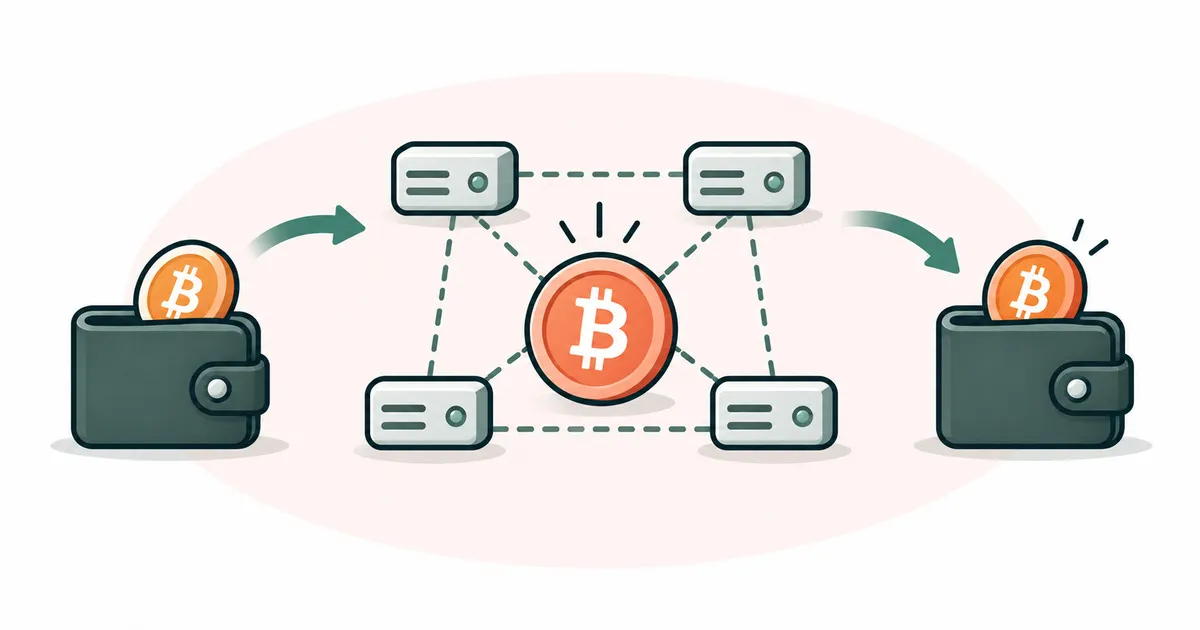
Cryptocurrency is digital money, that is, something that has value, that you can own and that you can pass to another person. It exists only in electronic form. It is not state money, no government obliges sellers to accept it, and it is run not by a bank but by a shared network of computers that keeps the record of who holds how many coins.
Compare it with money on a card or a bank account. Money on a card is a record in your bank's database, and the bank is in charge, it sees the transfer and can approve, delay or reverse it. Cryptocurrency is a record in a shared notebook, a copy of which thousands of participants hold at once. You cannot forge such a record single-handedly, because it has to add up across every copy.
Cryptocurrency is like cash in that it passes from hand to hand without anyone's permission, and the sender cannot take it back. From card money it takes the ability to send a transfer over the internet to anywhere in the world. In one phrase, it is like cash you can send over the internet. How exactly it resembles familiar money and how it differs is shown by the tables below.
From the fact that no one approves a transfer, two things follow at once. Since there is no one to approve it, there is no one to forbid it. But since there is no one to reverse it, a mistake cannot be undone and access to the money cannot be restored if you lose the key. Freedom here comes paired with responsibility.
Why does this matter to you? Working without a middleman, outside bank hours and borders, is useful where banks are slow, expensive or unavailable, this is sending money to family abroad (send money to family abroad), savings when the local currency weakens (protect savings from inflation) and paying for a freelancer's work (get paid in crypto). Don't take this literally, as "always and everywhere". You need the internet and a working network, and different countries have their own legal restrictions.
How cryptocurrency works, in more detail
Bitcoin came first, and it was meant as electronic cash
The first cryptocurrency was Bitcoin. Its creator described the idea simply, as electronic cash, a way to send money directly from one person to another, without a middleman 1. The "digital gold" label was attached later and conveys a later interpretation rather than the original intent. How the network itself works is covered by the profile Bitcoin.
The record is kept by thousands of computers at once, so it cannot be quietly forged
This shared record-keeping is handled by the blockchain, a shared ledger a copy of which many participants hold at once, so a record in it cannot be quietly forged (what is a blockchain). How exactly thousands of strangers agree on which record is true is covered by the article what is consensus. So you don't need to trust a single bank, because the whole network checks the record.
New coins are issued not by a central bank, but by rules written into the network's code
New coins appear not by a central bank's decision, but by rules written into the network's code when it launched. Bitcoin, for example, has a hard cap of 21 million coins 1. New coins go to miners and validators as a reward for keeping the network running. Tokens are a separate story, they are issued by projects on top of someone else's network, which the article what is a token covers. Issuance in detail is in the article what is issuance. So no one can "switch on" issuance at will, but there is also no guarantor answering for this money.
Coins don't sit in the wallet: the wallet keeps the key that gives the right to dispose of them
It's important to understand where coins "sit". Nowhere, because a coin is a record in the network, of which address holds how much. A wallet app keeps not coins but a secret key that proves you are the one entitled to dispose of that record (what is a private key). In case you lose the phone there is the seed phrase, a backup key, a set of words the wallet is restored from (what is a seed phrase). Where to keep the key, in a "hot" or a "cold" wallet, is covered by the articles hot and cold wallet and how to store crypto. So whoever has the key disposes of the money, which is why losing the key means losing the money.
Cash, money on a card, gold and cryptocurrency: how they are alike and how they differ
Cryptocurrency has traits of all three familiar ways to hold money. Like cash, it passes from hand to hand without a middleman. Like card money, it can be sent over a distance. Like gold, the amount of many coins is set not by people's decisions but by an outside rule. For gold that rule is nature, for a coin it is the network's code. Stablecoins and tokens are different, they are issued by a company or a project. Every convenience has a flip side, and that is shown in the tables below.
T1. Cash, money on a card, gold and cryptocurrency: how they work
| Cash | Money on a card or account | Gold | Cryptocurrency | |
|---|---|---|---|---|
| Who keeps the record | no one, the notes are simply with you | the bank | no one, if the gold is in your hands | the whole network at once (what is a blockchain) |
| Where new ones come from | printed by the central bank | issued by the central bank | mined from the ground, supply limited by nature | by rules in the network's code (what is issuance) |
| Is anyone's permission needed to transfer | no | yes, the bank's | no | no |
| Can it be sent over a distance | only in person or via a transfer service | yes, through the bank | only carried | yes, to any country if there is internet (send money to family abroad) |
| Does it work at night and on non-working days | yes | not always, transfers may wait for a business day | buying and selling during the seller's hours | yes, around the clock |
| Can the transfer be reversed | no | often yes, through the bank | no | no (how to send crypto) |
| What happens if you lose it or it's stolen | the money is gone | the bank blocks the card and restores access | the gold is gone | lost the phone, the seed phrase restores access, lost the seed phrase, no one restores it (what is a seed phrase) |
| Who sees how you use it | no one | the bank | no one | everyone, transfers are visible on the open blockchain, but without names, by addresses |
| Does the value change | loses purchasing power as prices rise | same as cash | the price fluctuates, but value holds for a long time | the price can change sharply even within a day, except for stablecoins (what is a stablecoin) |
| Is it the country's official money | yes | yes | no | no, in most countries (see the legality section below) |
T1b. Pros and cons of each option
| Pros | Cons | |
|---|---|---|
| Cash | needs neither internet nor a bank · no one sees it or can block it · transfer is instant | can only be handed over in person · easy to lose or have stolen · loses value as prices rise |
| Money on a card or account | convenient to pay and transfer · the bank reverses a mistaken transfer and restores access | the bank can delay or block a transfer · cross-border transfers are often slow and carry fees · loses value as prices rise |
| Gold | depends on neither a bank nor a state · has held value for centuries | hard to store, carry and divide · authenticity must be checked · the price also fluctuates |
| Cryptocurrency | a transfer to any country at any time without a middleman · the transfer itself no one will block (except stablecoins, see T2) · can be divided into very small parts | a transfer can't be reversed · lost the seed phrase, lost everything · the price can change sharply · needs the internet · laws differ across countries |
So cryptocurrency gives freedom, like cash, only over a distance, and like cash it does not forgive mistakes.
There are thousands of cryptocurrencies, made for different tasks
"I bought crypto" sounds too vague, because coins are made for different tasks. What there is, in the table.
T2. Kinds of cryptocurrency
| Kind | What for | Example | Pros | Cons | More |
|---|---|---|---|---|---|
| Network coin | pay for transfers and operations in its own network, store and send money | Bitcoin, Ethereum | independent of any company · the oldest and most time-tested networks | the price changes a lot | Bitcoin, Ethereum |
| Stablecoin | hold a price pegged to the dollar or another currency | USDT, USDC | the price barely swings · convenient to transfer and to keep savings | depends on the issuing company and its reserves · the company can freeze coins at an address · "stable" doesn't mean "guaranteed" | what is a stablecoin, what are reserves, what is a depeg |
| Token | access to a service, voting in a project | UNI, LINK | grants rights inside a specific project | value depends on the project · almost anyone can issue a token | what is a token, phishing and scams |
Meme tokens and NFTs are not in the table. An NFT is not a currency (what is an NFT). Meme tokens are a high-risk cryptocurrency with no backing and no clear value of any kind. So what matters is not to "buy crypto" in general, but to understand which coin you are taking and why.
The price of cryptocurrency is set by buyers and sellers, and no one guarantees it
The price is set by supply and demand on the market, and no one guarantees it, so it can change sharply. Stablecoins try to hold their price using reserves, but that too is not a guarantee (what is a stablecoin, what are reserves, what is a depeg). The current price of any coin is looked up on aggregator sites that collect prices from many exchanges, for example coinmarketcap.com . where to check: a price-aggregator site, e.g. coinmarketcap.com So since the money has no guarantor-issuer, no one holds its price for you either.
Cryptocurrency is not anonymous, not illegal, and not a scam in itself
Legality depends on the country
The network works without borders, and each country has its own laws. Most often you can own cryptocurrency and exchange it. You cannot pay with it everywhere, because it is recognized as legal tender almost nowhere. In many countries the income from cryptocurrency is taxed. What exactly is allowed in your country is on the country pages (Brazil, Kazakhstan, Argentina) and in the article how to handle crypto taxes.