


How to send money to family abroad with crypto
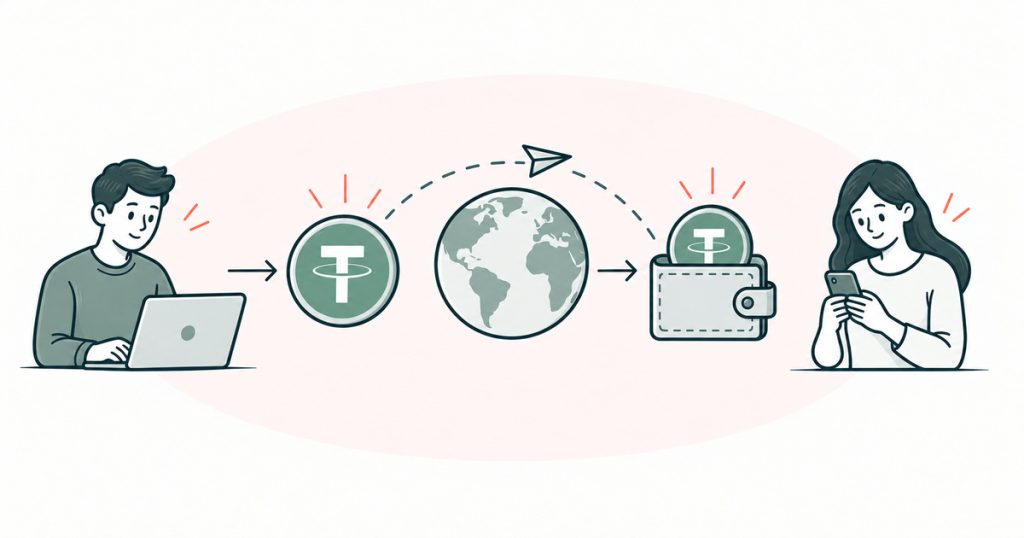
In plain words
Here is how you send money to family abroad through crypto. You buy a coin, usually a stablecoin so the amount barely changes in price along the way, and transfer it to the recipient’s crypto wallet. On their side they either keep it or change it into their local money. In a good corridor between two countries this comes out faster and cheaper than an ordinary bank transfer, but not always, so compare the whole path, not one step.
One thing to remember right away: the transfer goes to the address and the network you agreed on in advance, and if you send it to the wrong place, the money cannot be recovered. Below we walk through the path and how to lose nothing on it.
Deeper
Why it works and when it fits
The blockchain transfer itself, on a number of networks, goes through in minutes and without a chain of intermediary banks. But the method is a whole path, not one step: your ordinary money, buying the coin, the transfer over the network, the recipient selling it, and finally their local money. At each joint there is a fee, a rate, and a wait of its own. So “faster and cheaper” is not a promise but a possibility in a specific corridor. Count the total across the whole chain, not by the network fee alone.
So the amount does not ride on price swings along the way, people usually take a stablecoin, for example USDT — a coin whose price stays around a dollar (what that is, the article what is a stablecoin covers). For a transfer this is convenient: roughly as many dollars as you send is what arrives.
This describes the method, it is not advice to use it. It fits when the recipient already has a crypto wallet or is ready to set one up, when crypto can actually be changed into local money in their country, and when you both understand the risks and the rules of your countries.
How to send, step by step
- Buy the coin, preferably a stablecoin. The general order of buying is covered in the article how to buy crypto.
- Agree with the recipient on the wallet and the network. The recipient gives you their address and tells you which network their wallet accepts the coin on. The network has to be the same for the two of you, chosen in advance and together — it is not a guessing game: send on a different network and the transfer can be lost. If the recipient has no wallet yet, they set one up following the article how to store crypto, where the seed phrase is covered too.
- First send a small test amount. Send a little, wait for the recipient to confirm the money arrived and is visible in the wallet, and only then send the rest. How to pick the network, check the address, and not forget the memo when one is needed is covered in the articles how to send USDT and how to send crypto.
- The recipient keeps the coin or changes it into local money. If they just keep it, that is the end of it. If they need cash or money on a card, they usually have two paths. The first is an ordinary crypto exchange: the recipient sells the coin for local currency on their account and withdraws it to an account or card; this needs a verified account and works where the exchange supports withdrawal in local money. The second is P2P, that is, an exchange directly with another person through a platform: the platform holds the crypto in escrow, meaning it freezes it while the buyer sends the recipient money by a familiar local method, and releases the crypto only once the payment has arrived. P2P helps where an exchange has no direct withdrawal and gives more local payment methods, but it needs care: the crypto is released only after the money has actually landed in the account. Which methods and which rate are available in the recipient’s own country is visible on their local exchange or service. How to go through withdrawal safely is covered in the guide how to sell and withdraw crypto, and how to choose a platform in the article how to choose an exchange.
Risks and what to watch
- An error in the address or network is the main cause of losses. A blockchain transfer, once confirmed, usually cannot be undone, and getting the coins back rarely succeeds: it depends on the network, on who holds the keys on the receiving side, and on the service’s policy. The protection is simple: check the address and the network before sending, and always make a test transfer.
- A fee is not one number but the sum of three. You pay on the way in when buying, on the network for the transfer itself, and on the way out when the recipient withdraws. So a cheap network fee does not yet mean a cheap transfer overall. Look across all three layers, and for the current numbers, the fee pages of the services.
- A stablecoin is reliable but not “risk-free.” In rare cases it can come off the dollar, which is called a depeg, the article what is a depeg is about that. And even when it holds the dollar exactly, the dollar itself loses force over time to inflation, and its rate against local currency changes anyway.
- Legality is broader than taxes. An international transfer can have not only tax consequences but currency restrictions, sanctions rules, licensing requirements for platforms, limits on P2P, and a request to confirm the source of the money. And the rules of one’s own country apply to both the sender and the recipient, so you need to check on both sides. Where to start — the articles taxes by country and how to handle crypto taxes, and the exact answer always against official sources.
- Fraud on urgency. The classic scheme is a message like “a relative urgently asks you to transfer money.” Before you send, reach that person through another, familiar channel and make sure the request is real (see phishing and scams).