


What is a blockchain hard fork?
In plain words
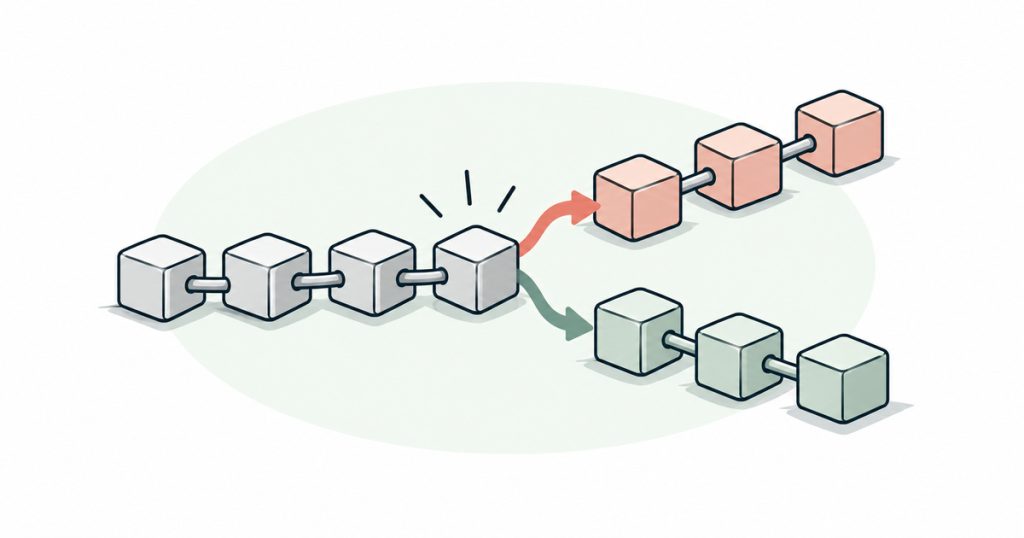
A hard fork is a deep change to a blockchain’s rules that is incompatible with the old rules. Put simply, it is a change to the network’s own program code. If part of the network moves to the new rules and part stays on the old ones, the chain can split in two. Sometimes a new, separate coin appears this way.
Picture a big board game that has released a rules update, and not everyone agrees: those who disagree keep playing the old way, and you get two different games with a shared past up to the moment of the dispute. That is how, in crypto, separate coins were born from a single network, for example Ethereum and Ethereum Classic or Bitcoin and Bitcoin Cash. We’ll look at exactly how below.
Why does it matter to you? Forks explain where related coins with similar names come from, and this is part of the history of almost any large network. The history and forks line is in a coin’s profile.
Deeper
Why a network can split
In a blockchain there is no boss who forces everyone to upgrade, which the article what is consensus is about. If there is no agreement about a change, each node decides for itself which rules to run. If everyone’s rules match, the network stays united. If they diverge irreversibly, you get two chains with a shared history up to the split point, and their own beyond it.
Two well-known examples
The first example is Ethereum and Ethereum Classic in 2016. After a major hack of a project called The DAO, the community decided to change the rules to roll back the consequences. Some participants disagreed and continued the former chain, so Ethereum Classic appeared. The hard fork took place on 20 July 20161. This is a classic case where the split is about principles, not technique.
The second example is Bitcoin and Bitcoin Cash in 2017. Out of a dispute over how to scale the network, on 1 August 2017 Bitcoin split, and a separate coin, Bitcoin Cash, appeared with an increased block size2.
A fork does not always mean a split
Not every fork gives birth to a new coin. In essence a fork is a change to the network’s rules in code. A separate coin appears only when there is no agreement about that change and some participants stay on the old rules. Often, though, it is a planned upgrade that practically everyone accepts. Then the network simply moves to the new rules without dividing, which is how Ethereum’s upgrades went, for example. A split happens only where there is no agreement.
Another thing is important too. After a fork, related coins become different assets with their own histories, and they should not be confused. The details of a specific fork are covered in the profile of the corresponding coin.