


How to get paid in crypto (for freelancers)
In plain words
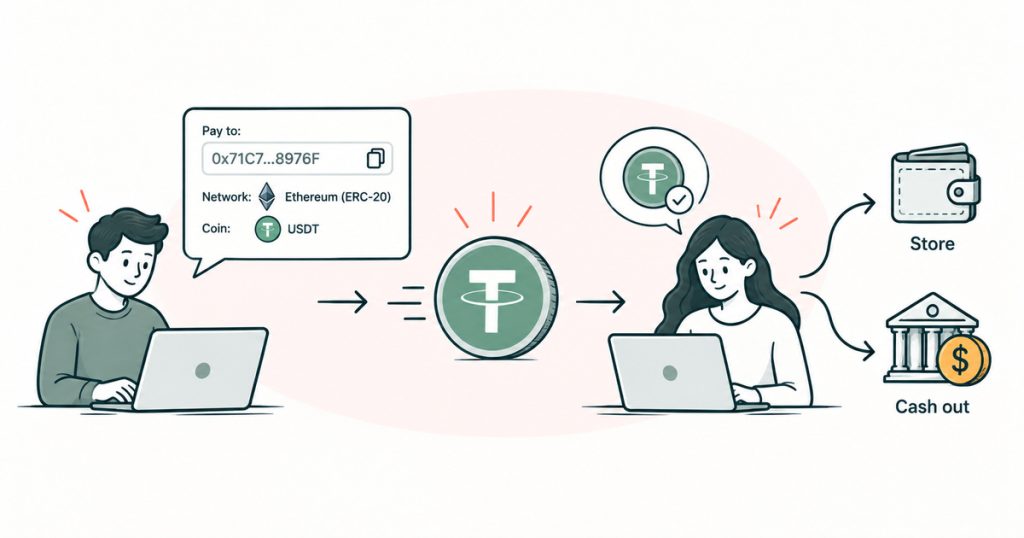
Getting paid in crypto means agreeing the price, coin, and network with the client, giving your address, receiving the transfer (usually in a stablecoin, so the amount depends less on price swings), and deciding right away whether to store it or change it into local money. People lose the most where they did not agree the network and address in advance, or where they did not fix the price and rate.
The same coin travels over different networks, and your network and the client’s must match, otherwise the transfer may not arrive and not come back. Agree the coin and the network before payment, give the exact address, and ask for a small test amount first, with the rest only once it is visible in the wallet.
Deeper
Why it’s convenient for a freelancer
An international bank transfer can be slow and expensive. The blockchain transfer itself goes through in minutes on a number of networks and without correspondent banks, though the chain can still involve the stablecoin’s issuer, an exchange or payment service, a custodial wallet, and the banking system at cash-out, so the total time and cost depend on the whole chain rather than on a single step.
So that the amount rides less on rate swings along the way, people usually take a stablecoin rather than a “floating” coin (what is a stablecoin, for example USDT or USDC), whose price stays around a dollar. It reduces short-term swings compared with Bitcoin, but does not guarantee an unchanging value.
This describes how it’s done, not advice or a promise, since crypto has its own risks and taxes on income have not gone anywhere (see below).
Agree before the work: price, network, and fee
The coin’s rate can change between the moment you agree and the moment of payment, so it’s worth fixing the price. You can name the amount in your own currency and agree in advance at what rate and as of which moment it converts into the coin, or invoice directly in a stablecoin so the amount barely floats. Separately, spell out who pays the network fee, otherwise you receive the amount already minus the gas rather than the full sum.
All of this is best fixed in writing in an invoice or contract: the coin, the network, the address, the amount, the payment deadline, and whose fee it is. Many wallets also show the address as a QR code, which reduces the risk of a typo when entering it.
How to do it, step by step
- Set up a wallet and deliberately choose where to store it. Your own wallet (you hold the keys) gives direct control but requires making your own backup and safely storing the seed phrase; a custodial service takes some of the technical load off but adds venue risk and its withdrawal limits. How to choose and set one up is covered in the article how to store crypto, and what everything rests on in an ordinary wallet is covered in what is a seed phrase.
- Agree the coin and the network, give the address. The same coin travels over different networks, and your network and the sender’s must match. Give the client an address; a human-readable name (see ENS) is worth using only if the sender’s wallet supports resolving it for the chosen network and shows the expected address before sending. If you receive to an exchange and it shows a memo or tag (a short note added to the transfer so the money is credited to the right account), pass it along with the address and network. The details are covered in the articles how to send USDT and how to send crypto.
- Receive a test amount first. To a new address, ask for a small amount first, make sure it arrived and is visible, and only then accept the rest.
- Decide whether to store or cash out. Storing safely is helped by the article how to store crypto. You can cash out into local money via an exchange or P2P, and method availability depends on the country; how to go through withdrawal safely is covered in the guide how to sell and cash out crypto, and how to choose a venue in the article how to choose an exchange.
Storage is a trade-off, not “your own is always safer.” Your own wallet removes venue risk but shifts to you the risk of losing the key and of a transfer mistake; the custodial option is the reverse. Choose for your own situation, not by a general rule.
Keep records and keep work money separate
For bookkeeping and taxes it is convenient to keep a work wallet separate from your personal crypto, so income for work does not mix with everything else. For each payment, save a short record: the date, the coin and amount, the transfer’s identifier (the transaction hash, by which it is visible in a network explorer), the value in your currency on the date received, the source of that rate, and the fees paid. Such a history makes taxes noticeably easier, since receiving payment is often counted as income at its value on the date received.
What to keep in mind when accepting payment
A wrong network, address, or forgotten memo is the main cause of losses: the transfer may not arrive and not come back, so verify everything in full and always send a test. Keep in mind separately that almost identical addresses exist, matching at the start or the end, so check the whole address. Remember gas too: to send or cash out the coin yourself later, the wallet also needs the network’s own coin for the fee (what is gas).
A blockchain transfer has no bank to reverse the payment, so a mistaken or excess transfer can be returned only by the other side’s goodwill. For a large job this is a reason to split payment into stages rather than take it all in one transfer up front or at the very end.
The peg to the dollar breaks in rare cases (what is a depeg), liquidity and withdrawal problems are possible, and behind a fiat stablecoin stands a company. The issuer of some centralized fiat stablecoins, for example USDT and USDC, can technically block an address or freeze tokens in the cases its rules and the law provide for (what are reserves).
The classic schemes are “an overpayment, refund the difference,” a request to follow a link, or to connect your wallet to an unfamiliar site. Before refunding or signing anything, re-check the client’s identity and the request itself through a familiar channel (see phishing and scams).
Legality is broader than taxes. Accepting payment from abroad can have not only tax consequences but currency restrictions, reporting rules, and requirements for platforms, and the rules of one’s own country apply to both you and the client. Where to start is covered in the articles taxes by country and how to handle crypto taxes, while the exact answer is always against official sources.
Receiving payment may be counted as income at its value on the date received, and a later sale or exchange may be a gain or loss relative to that value. The exact model depends on the country. We don’t give tax advice: the general walkthrough is in the article how to handle crypto taxes, the specifics in the section taxes by country, and when in doubt it’s better to check with an accountant or a tax adviser in your country.
Where to go next
To accept payment safely, look at the articles how to send USDT and how to store crypto. To understand the tool, what is a stablecoin, USDT and USDC help. To cash out, the guide how to sell and cash out crypto. To sort out the rules of your country, start with the section taxes by country and the article how to handle crypto taxes.