


Bitcoin (BTC) — the first cryptocurrency
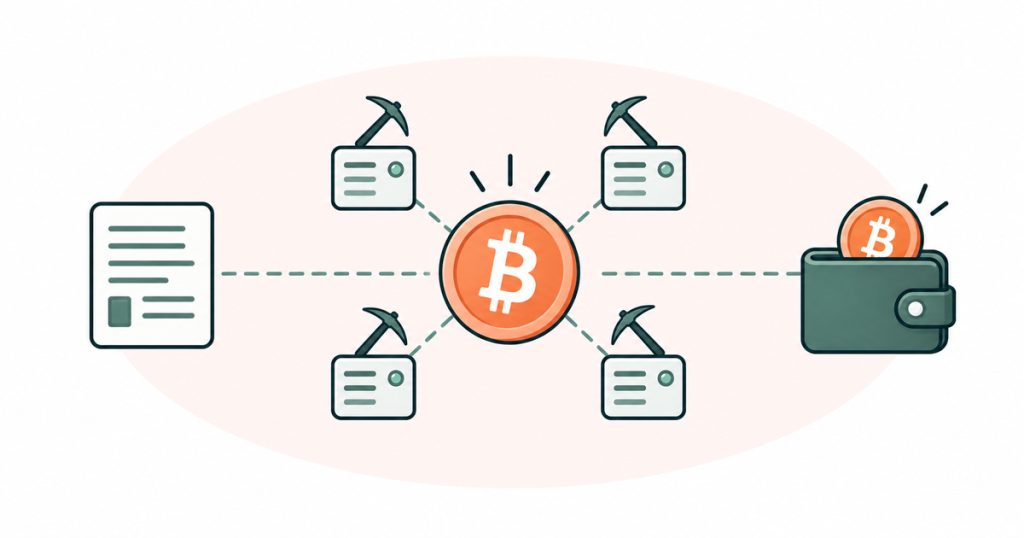
How it works
Bitcoin is the first cryptocurrency and the first blockchain to see wide use (what a blockchain is — in the article what is a blockchain). It was conceived as “electronic cash”: a way to pass money directly from person to person, without a bank as a go-between1.
Who created Bitcoin is not known for certain: the author worked under the pseudonym Satoshi Nakamoto, and who that really is remains a mystery — one we do not guess at. For a beginner it is enough to understand this: Bitcoin is the “original” that the whole industry started from, and the most recognizable way into the topic. It is often called “digital gold,” but that image was attached later; it was not the original idea.
Bitcoin has its own network, secured by a method called Proof of Work, literally “proof of work done.” Put simply: special participants, the miners, spend their computers’ power and electricity competing for the right to add a new page of records — a block — to the shared history. Whoever manages it first adds the block and is rewarded with new coins, and more on this is in the articles miners and validators and what is consensus. Bitcoin has nothing like “freezing coins as collateral,” which is called staking. The network adds a new block roughly every ten minutes, and this is what determines how quickly your transfer gets a confirmation.
How many coins there will ever be is set in advance. This is called issuance — how and how many new coins appear. Bitcoin has a hard limit: no more than 21 million coins, and new ones come out ever more slowly. Roughly every four years the reward per block is cut in half, an event known as the halving (from “half”), so over time issuance almost fades away. The idea of a pre-set, decreasing issuance is spelled out in Bitcoin’s original document1, and more on how coins are issued is in the article issuance. No one received coins in advance, either: some projects hand themselves a share before launch, before any mining at all, which is called a premine, but Bitcoin had none — from the very start coins appeared only through the miners’ work.
The network’s capabilities are deliberately modest. Bitcoin can check simple conditions for transfers, but it cannot run complex programs with arbitrary logic — such programs, called smart contracts, belong to Ethereum and similar networks (see smart contract). For every transfer you pay the network a small fee, and the miners receive it. This is not “gas” in the Ethereum sense, and the article what is gas explains the difference.
Bitcoin transfers are visible to everyone, but not signed with a name. They all stay in the open shared history forever, and this is not anonymity: an address is not your name, but if someone wants to, it can be linked to a person, so it is more accurate to say “pseudonymous” than “anonymous.” The address itself comes in several formats: older ones start with “1” or “3”, newer ones with “bc1”, and when sending, it matters that the address and the chosen network match (see how to send crypto).
Once, out of a dispute over how to speed the network up, a separate coin, Bitcoin Cash, split off from Bitcoin in 2017, and how that comes about is explained in the article hard fork.
There are also exchange-traded funds for Bitcoin, called ETFs: through such a fund you can get exposure to the price of bitcoin from an ordinary brokerage account, without buying bitcoin itself. Spot Bitcoin ETFs have traded in the US since 20242. The specific list of such funds changes — where to check: the regulator’s site or an exchange aggregator.
Where to check current Bitcoin data
- Price, fee size, number of confirmations for a transfer, hashrate — where to check: a Bitcoin network explorer.
- The current list of spot ETFs — where to check: the regulator’s site.
Properties
- Transferring value without an intermediary (the original intent)
- Long-term saving — the "digital gold" image
Bitcoin is not a stable coin: its price can rise sharply and fall just as sharply, and no one knows it in advance (stable coins are built differently — see what is a stablecoin). And there is something else that matters: in crypto there is no bank that will “restore your access,” so keeping your coins safe is on you alone. What that means in practice, and how not to lose access, is covered in what is a seed phrase and how to store crypto.