


Services
› Infrastructure › ENS (service)
Infrastructure
ENS (service)
Infrastructure · Infrastructure protocol (names)
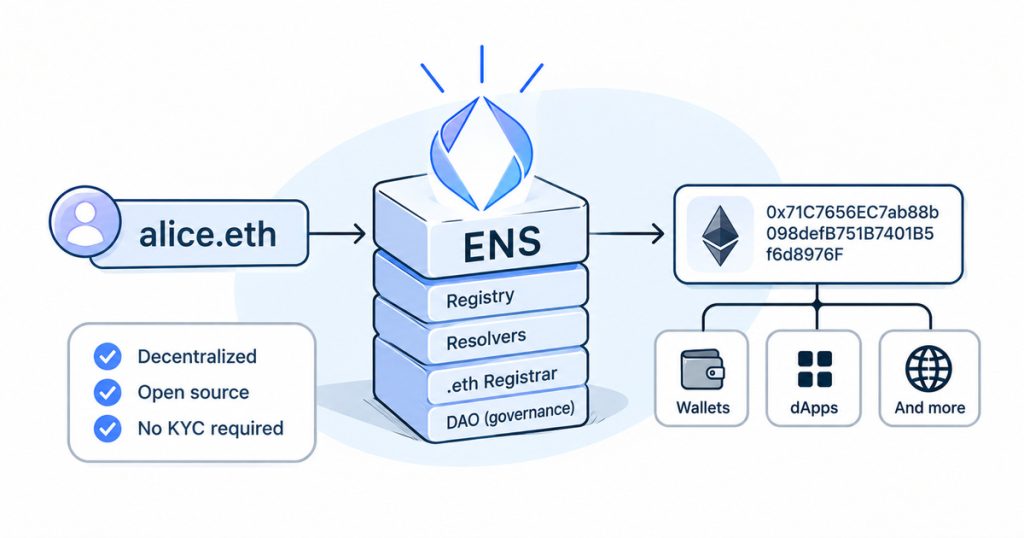
A decentralized name protocol: alice.eth instead of "0x…". The "phone book" of the crypto world, governed by its community.
✓ Verified 25 Aug 2026
How it works
ENS (Ethereum Name Service) is an infrastructure name protocol. It replaces long addresses (“0x…”) with human-readable names like alice.eth and works as the “phone book” of the crypto world: wallets and apps show a name instead of a string of characters. Below is how it works and what to look at.
ENS has two sides that are easy to confuse. The name .eth itself is an asset (an NFT), covered on a separate page, ENS (.eth name). This page is about the protocol and the service. One brand, two different entities.
- Holds nothing. ENS only maps names to addresses; it moves no money and holds no funds.1
- What it is made of. The registry and resolvers are the protocol contracts: the registry records who owns a name and which resolver answers for it, while the resolver turns the name into an address and other records. The .eth registrar is how a name is registered for a term and renewed. The manager app (the ENS website interface) is just a convenient frontend, while the protocol runs independently, and you can work with a name through different wallets and interfaces.
- Self-custody. ENS does not store your money; the name belongs to you directly, without intermediaries.
- Community-run. Rules and prices are set by the ENS DAO — the community of ENS governance-token holders (on governance tokens, see what is a token).
- Open source, no account or KYC. Only registration of the name itself in the network is required.
- Network. Ethereum and a growing number of others.
Why it matters to a beginner
- A readable name lowers the risk of a mistake when sending. Checking
alice.ethis easier than a long string of characters (but still verify — see how to send crypto). - The name works across many wallets and apps at once.
Security
✓
Open source, governed via a DAO
The code is open; the protocol is governed by the ENS DAO community.
i
Look-alike names and typos
Check which address a name is actually tied to — look-alikes of alice.eth are used in deception (see phishing and scams).
i
Name ownership term
A name is registered for a term and renewed periodically. Miss the renewal and there is a grace period (around 90 days), after which the name is released and someone else can take it.
i
Dependence on the network and contracts
As infrastructure, ENS depends on the Ethereum network and its own smart contracts.
Sources
Every fact-flag is verified separately. We don't publish changing rates — we link to "where to check".
1
Decentralized name protocol; non-custodial, community-governed via the ENS DAO ens.domains · archive ↩ Verified 18 August 2026 · primary source