


A beginner’s first mistakes in crypto — and how to avoid them
In plain words
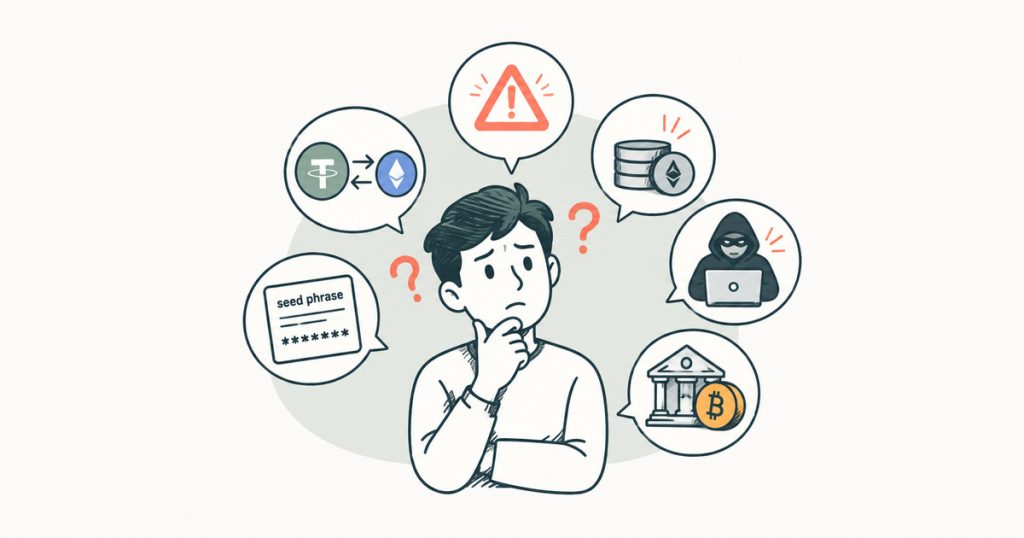
Many losses for newcomers come not only from a “hack” but from a few typical mistakes and from scams — and most of them are preventable with a couple of minutes of attention. Here are five common situations and what to do instead.
Deeper
Five common mistakes
- Sending on the wrong network. The same coin (for example USDT) travels over different networks, and a transfer on an unsupported or wrongly chosen network may not show up for the recipient or may become inaccessible. Sometimes recovery is possible — for example, if the recipient controls the same address on a compatible network — but it isn’t guaranteed. Always check the network on both the sender’s and the recipient’s side — more in how to send crypto and how to send USDT.
- Losing or showing your seed phrase. In a wallet based on a seed phrase, it effectively gives control over all the accounts derived from it. Don’t photograph it, store it in the cloud or in chats, or tell it to anyone: real support never asks for it. Why — what is a seed phrase. (Some wallets — MPC, multisig, smart accounts — handle recovery differently.)
- Forgetting the coin for gas. To send a token, a wallet usually also needs the network’s own coin — for the fee. You have the tokens but no gas, and the transfer won’t go. (Modern smart accounts sometimes let you pay gas differently, but by default count on the native coin.) A walkthrough — what is gas.
- Rushing and falling for a scam. Haste and a “too good” offer are a scammer’s signature: fake sites, “giveaways,” a request to sign something without looking. How to spot the traps — phishing and scams.
- Keeping everything on an exchange without a conscious choice. While the coins are on an exchange, it controls the keys, not you. For savings, the choice between custodial storage and your own wallet is worth making deliberately: the first adds venue risk, the second adds the risk of losing keys and owner mistakes. A walkthrough — how to store crypto, what is a private key.
The general rule
Most of these mistakes share one root — haste and taking things on trust. Slow down at the important steps: verify the network and address, send a small test amount first, don’t sign what you don’t understand. A couple of minutes of checking is almost always cheaper than a lost transfer: a confirmed blockchain transfer usually can’t be reversed, and only the recipient or the service can return the funds, if it technically controls the address and agrees to help. The basic beginner route — getting started in crypto.