


Services
› Exchange › Kraken
Buying
Kraken
Exchange · Centralized exchange (CEX)
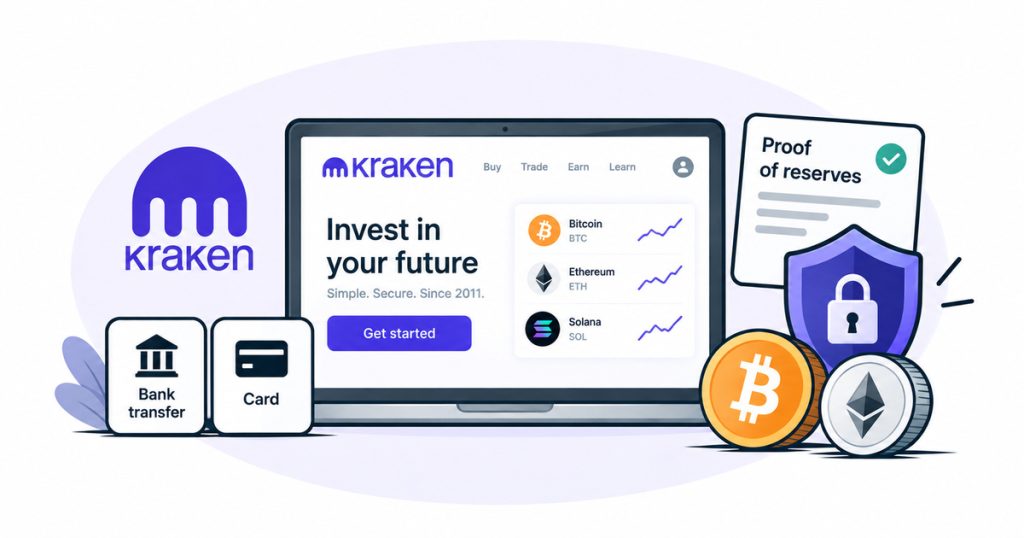
One of the oldest US exchanges: custodial, KYC, publishes proof-of-reserves. No scores — fee layers and verifiable facts.
✓ Verified 27 Aug 2026
Objective data
Official sitekraken.com
TypeCentralized exchange (CEX)
Deposit
Assetsaround 638 · current number — on the service's site
How it works
Kraken is one of the oldest US centralized exchanges, known for a security reputation and for the practice of publishing proof-of-reserves. But there is no best exchange in general — it all depends on your task and your country. Below is not a score, but a breakdown of how the service works and what to look at yourself.
- Type — a centralized exchange (CEX). The company matches buyers and sellers and holds the funds itself.
- Control of funds — custodial. While the coins are on the exchange, Kraken controls the keys, not you (see what is a private key). For holding larger amounts it is better to withdraw to your own wallet (see how to store crypto).
- KYC — yes: identity verification is required; its extent and limits depend on country and account level. Registration is required.
- Launch and headquarters. Operating since 2011; San Francisco, USA.
- Assets and networks. Supports many coins and networks; the exact list changes.
- Fiat rails. Deposits by bank transfer and card — availability depends on the country.
Who it suits, who it doesn’t
- Suits: someone who values a long service history and the publishing of reserves — understanding that funds are under the exchange’s control.
- Suits less: if full control of the keys matters (then — self-custody), or if the service is restricted or unavailable in your country.
Fees
1
Depositing money
Card is usually more expensive; bank transfer is cheaper.
2
Trading / swapping
A trade fee (maker/taker); the simple ("instant") buy interface usually carries a higher markup than the professional mode (Kraken Pro).
3
Withdrawing crypto
A network fee that depends on the chosen network. For a beginner the deposit method and the buy mode matter most (simple is dearer than professional); actual figures change — where to check: Kraken's fees page.
Security
✓
Publishes proof-of-reserves
Kraken publishes proof-of-reserves — a mechanism that lets you verify the backing of customer balances — where to check: Kraken's proof-of-reserves page. This is a verifiable practice, not a "trust rating".
i
The 2023 SEC settlement
On 9 February 2023 Kraken settled charges with the US Securities and Exchange Commission: the company agreed to discontinue its staking-as-a-service program in the US and to pay $30 million. This is a dated fact, not the current status; check the current availability of products against official sources.1
How to judge for yourself
- Licenses in your country — and what they actually cover.
- The history of incidents and how the exchange closed them.
- Whether it publishes reserves — not someone else’s “trust rating”.
Compare with others
Back to the choice: objective slices and why there is no "best overall".
Sources
Every fact-flag is verified separately. We don't publish changing rates — we link to "where to check".
1
SEC press release 09.02.2023: Kraken discontinues its US staking-as-a-service program and pays $30M; a dated fact, not current status U.S. Securities and Exchange Commission · archive ↩ Verified 27 August 2026 · primary source