


How to choose a crypto wallet?
There is no single \”best wallet\”. The right one is the one that fits your task. The popular query \”best crypto wallet\” is usually answered with paid rankings, so we lay wallets out by verifiable features and show what to look at, leaving the choice to you.
Before you choose, answer three questions for yourself.
- How much money, and how often will you use it? Small everyday amounts and long-term savings are different tasks, and they call for different wallets.
- Are you ready to be responsible for the keys yourself? Every wallet in our catalog is non-custodial: the keys are held by you alone. There is no bank or support desk here to \”restore access\” if you lose them. You alone are responsible for keeping them safe (what a key is and why it matters so much — in what is a private key).
- Will the wallet be online all the time, or kept offline? That is essentially the choice between a hot and a cold wallet (see hot and cold wallet).
- You need an everyday wallet on your phone or in the browser. Those are hot wallets, for example Trust Wallet.
- You want to keep savings and hold the keys offline. Those are cold, hardware wallets, for example Ledger.
- Your main concern is not slipping up on your first send. Look at how the wallet warns you about mistakes: the wrong network, a suspicious address. We cover this in the reviews themselves.
- You want to understand how much the wallet charges for a built-in swap or purchase. Look at the rate, because the markup (the spread) hides inside it — not at a \”0% fee\” line. There\’s a clear example in the Trust Wallet review.
It\’s more useful to learn to read facts than to trust a \”trust rating.\” Here\’s what to check:
- Custody: whether the keys are with you or with the service.
- Hot or cold: convenience versus protection.
- Protection against beginner mistakes: whether the wallet warns about the wrong network and a suspicious address.
- Transparency of the built-in swap and purchase: whether the spread and markup are visible before you confirm.
- Incident history: whether there were any and how they were handled.
Below are objective slices by verifiable features — for example, whether a wallet is hot or cold and how many networks it supports. They are assembled from the services\’ data automatically: the order is justified by fact, not opinion.
A slice of wallets by a single fact — whether it's connected to the internet: how hot and cold differ and how to choose between them.
Security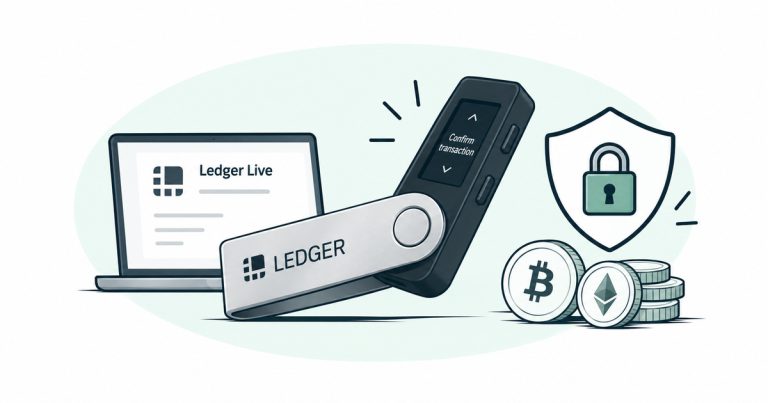 Ledger
A hardware (cold) wallet: keys offline, every send confirmed on the device itself. The offline key reduces the risk of remote theft — this type is usually chosen for savings; paid and less convenient for everyday use.
Storing and wallets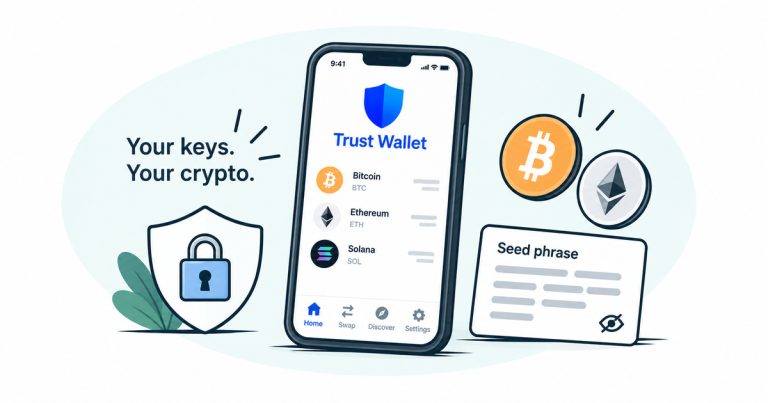 Trust Wallet
A popular non-custodial hot wallet: many networks under one seed phrase. Free — but the earning hides in the spread and the markup.