


Services
› Wallet › Trust Wallet
Choosing a wallet
Trust Wallet
Wallet · Non-custodial wallet (hot)
A popular non-custodial hot wallet: many networks under one seed phrase. Free — but the earning hides in the spread and the markup.
✓ Verified 25 Aug 2026
How it works
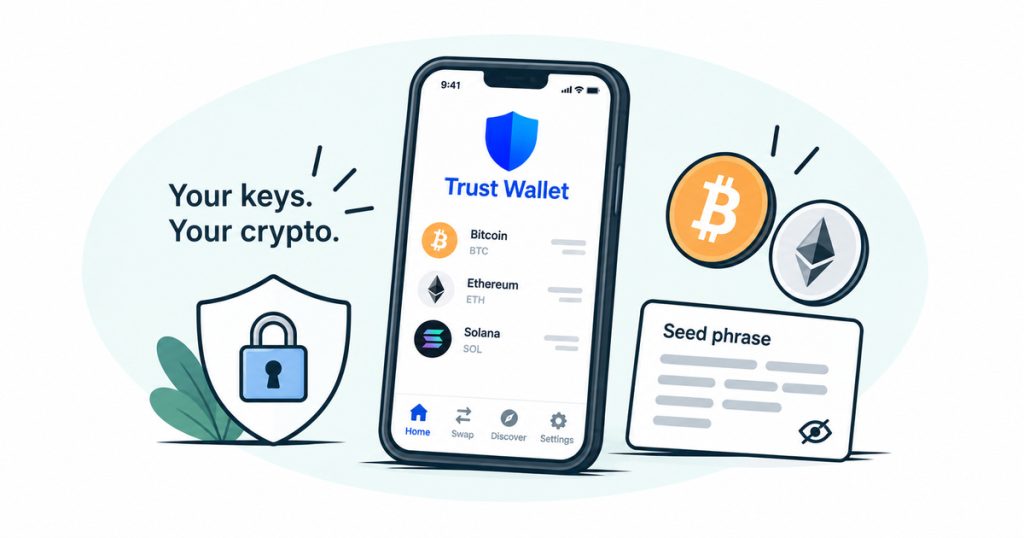
Trust Wallet is a popular non-custodial wallet: a phone app and a browser extension. The main thing for a beginner — the keys are yours: Trust Wallet does not store them and cannot “restore access”, everything rests on your seed phrase (see what is a seed phrase). This is at once freedom and responsibility. There is no best wallet “in general” — below is how it works and what to look at.
- A hot wallet (see hot and cold wallet): lives on an internet-connected device. Convenient for everyday amounts; for large ones a cold wallet is safer.
- Control — non-custodial. The keys and seed phrase are kept on your device, not with the company; the wallet can be recovered only with the seed phrase (compatible with the BIP39 standard).
- KYC — no: to set up a wallet, no passport or email is needed.
- Coverage. Many networks and coins (Bitcoin, Ethereum, Solana, Tron, etc.) under one seed phrase — convenient if you hold a variety and do not want a separate wallet for each.
- Protection against mistakes. On receipt the wallet warns about the risk of the wrong network — valuable for a beginner, since a wallet’s main risk is not a hack but your own mistake.
- Owner — tied to Binance.
Who it suits, who it does not
- Suits: a beginner who needs one wallet for BTC/ETH/Solana/Tron with a single seed phrase and card purchase without leaving the app — with the understanding that responsibility for the keys is on them.
- Suits less: for large, long-term savings in the browser extension (a cold wallet or at least the mobile app is better) and if fully open source is needed.
Fees
1
Swap inside the wallet
The service states a 0% fee, but the earning is "baked into the rate" (the spread). Check the rate itself against the market before confirming.
2
Card purchase
Goes through third-party providers, and Trust Wallet adds its markup on top of their price.
3
Network fee (gas)
Usually paid on top — in the network's own coin. But the native coin is no longer always required: there is FlexGas (paying gas with supported tokens, e.g. TWT/USDT/USDC/BNB) and Gas Sponsorship (the service sponsors part of the fees); availability depends on the network and asset.2
Security
!
Extension and mobile app: different track records
In December 2025 a supply-chain attack slipped a malicious update into the browser extension that exposed seed phrases; the mobile app, by the company's statement, was not affected. Practical takeaway: keep less in the extension.1
i
Open source — partially
Only the core (key handling) is open; the app and the extension themselves are closed. "Open source" here is about the component, not the whole product.
✓
Warns about beginner mistakes
Warns about the wrong network on receipt — a wallet's main risk is not a hack but your own mistake.
How to judge for yourself
- Does the wallet warn about mistakes (the wrong network, a suspicious address).
- Is there a history of incidents and how were they closed.
- Is the spread disclosed honestly.
Compare with others
Back to the choice: objective slices and why there is no "best overall".
Sources
Every fact-flag is verified separately. We don't publish changing rates — we link to "where to check".
1
Dec 2025 supply-chain attack on the EXTENSION; mobile app not affected per company statement Trust Wallet — browser extension v2.68 incident · archive ↩ Verified 18 August 2026 · primary source
2
Paying gas with supported tokens (TWT/USDT/BNB, etc.) and fee sponsorship (Gas Sponsorship) Trust Wallet — FlexGas (blog) · archive ↩ Verified 22 June 2026 · primary source