


Services
› Wallet › Ledger
Choosing a wallet
Ledger
Wallet · Hardware (cold) wallet
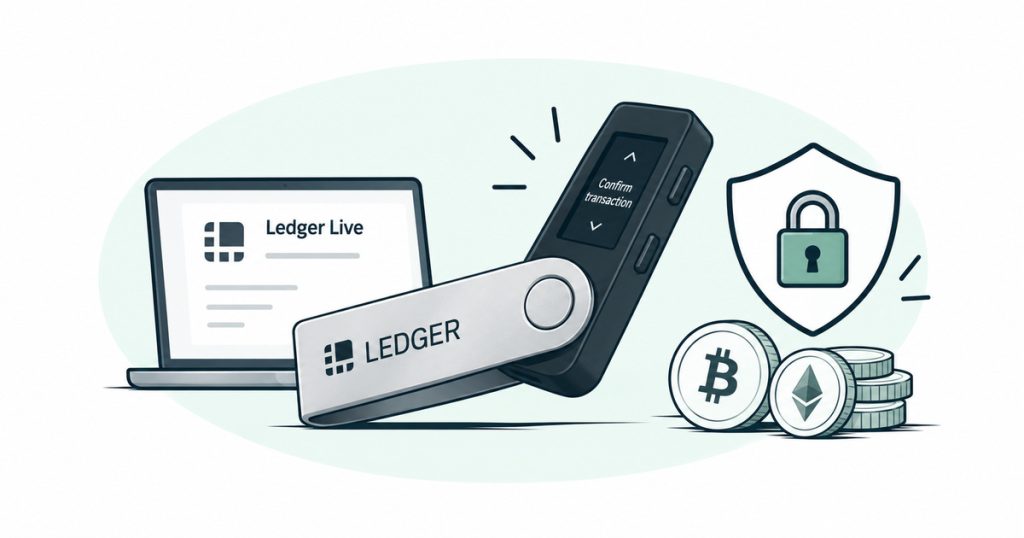
A hardware (cold) wallet: keys offline, every send confirmed on the device itself. The offline key reduces the risk of remote theft — this type is usually chosen for savings; paid and less convenient for everyday use.
✓ Verified 24 Aug 2026
How it works
Ledger is a hardware (cold) wallet: a separate physical device on which keys are stored offline. You confirm each operation with buttons on the device itself, so it is hard to move funds even from an infected computer. It is the opposite of a hot wallet like Trust Wallet: the offline key reduces the risk of remote theft, which is why this type is usually chosen for savings — but it is paid and less convenient for everyday use. There is no best wallet “in general” — it is all in the task.
- A cold wallet (see hot and cold wallet): keys are stored on the device offline. To transfer, you connect it to a computer or phone, but the signing happens inside the device — the private signing key itself does not go out.
- Control — non-custodial. The keys and seed phrase are yours; by default the company does not store access and will not return it, and recovery is only with your seed phrase (see what is a seed phrase).
- Optional recovery (Ledger Recover). Ledger offers a separate paid service, Ledger Recover: if you turn it on, encrypted fragments of your seed phrase are handed to third parties for safekeeping so that it can be restored. This adds a recovery method but also changes the threat model — a backup of the seed exists off the device, with third parties. Recover is off by default; whether to enable it is your decision, and it affects the claim that “the key is stored only with you”.
- Confirmation on the device. Any send must be approved physically on the Ledger itself — this is what protects against malware on the computer.
- The companion app (Ledger Live) — for viewing the balance and sending; the key itself lives in the device, not in the app.
- Cost. The device is paid — unlike a free wallet app. KYC — no.
Who it suits, who it does not
- Suits: for savings and large amounts you do not touch every day; those ready to buy a device and keep it carefully.
- Suits less: for frequent small operations (a hot wallet is more convenient there) and if you are not ready to store both the device and the seed phrase.
Fees
1
The device
Paid, one-time — unlike a free wallet app. The price — where to check: Ledger's official site.
2
Network fee
As everywhere: transfers cost the network fee of the coin you move.
Security
✓
Key offline, signing on the device
Moving funds remotely is extremely hard: any send is confirmed by hand on the device itself.
i
Recover is a choice, not a given
If you enable the paid Ledger Recover, encrypted backup fragments of the seed will be held by third parties; if you don't, recovery rests only on your seed phrase, and losing it is unrecoverable. Both models are valid — what matters is knowing which one you chose.
i
Customer data leak (2020)
Contacts of buyers leaked from a marketing database (emails of over a million people; for hundreds of thousands — names, phones, addresses), after which a wave of phishing and extortion followed. Crucially: customer data leaked, not keys — devices and funds were not affected.1
i
Buy only from an official seller
A device "secondhand" or from an unclear source may be tampered with.
How to judge for yourself
- Exactly how the key is stored and whether it can leave the device.
- Whether Ledger Recover is enabled and to whom the encrypted seed fragments go.
- How recovery works (the seed phrase; with Recover — a different model).
- Whether the incident history is disclosed honestly — and what exactly leaked: data or keys.
Compare with others
Back to the choice: objective slices and why there is no "best overall".
Sources
Every fact-flag is verified separately. We don't publish changing rates — we link to "where to check".
1
2020 marketing-database leak: customer DATA, not keys; phishing wave followed Efani — Ledger security breaches timeline · archive secondary ↩ Verified 18 August 2026