


Ethereum (network) — a platform for tokens and apps
Overview
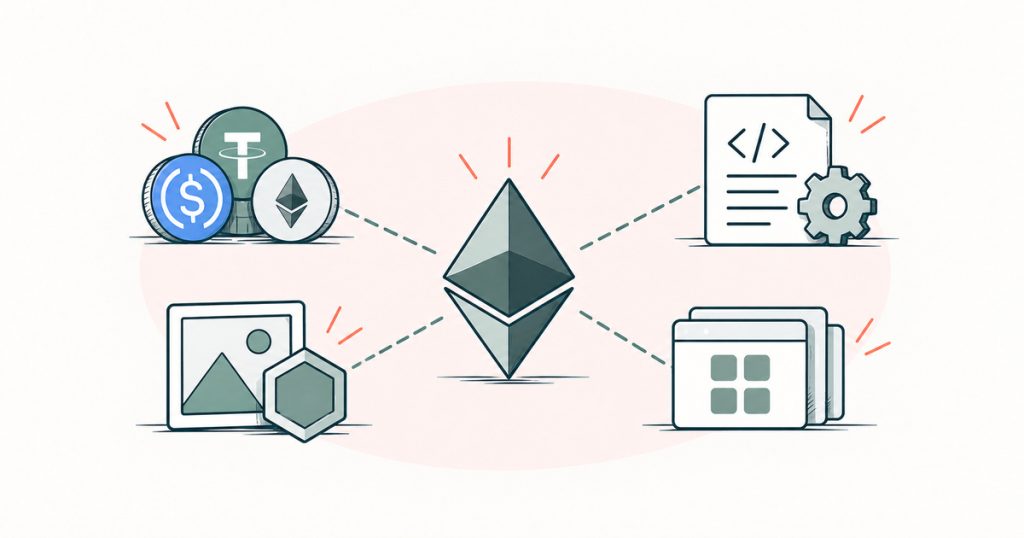
Ethereum is the crypto network where “smart programs” took hold. A smart contract is a program written right into the blockchain that executes a built-in rule by itself, without an intermediary (more in the article smart contract). Put simply, Ethereum works as a platform: tokens, stablecoins and NFTs are issued on top of it and apps are built inside the network. It was launched in 2015 by Vitalik Buterin and a team1. The network’s native coin is ETH, its profile is in the article Ethereum (ETH).
How the Ethereum network works
The network is secured through staked coins, a method called Proof of Stake (“proof of stake”): participants freeze their coins as a pledge of honest work rather than spending electricity on computation. Ethereum switched to it in 2022, an event known as The Merge2. Who exactly keeps the network running is covered in the article miners and validators. The very idea of a network with programmable contracts was described in Ethereum’s technical document (whitepaper)3.
Programs for Ethereum are written in a special language, most often Solidity (there are others, for example Vyper). A finished smart contract is run by the network on a shared “virtual computer” called the EVM (Ethereum Virtual Machine), the same way for everyone. That is why all sorts of applications are built on Ethereum: decentralized exchanges and lending services (grouped under DeFi, that is, finance without a bank as an intermediary), communities governed by shared voting (called DAOs), NFT marketplaces and collections, games and much more.
For every transfer or action in the network you pay a small fee, called “gas” (see what is gas). Tokens on Ethereum are issued in the common ERC-20 format, so that wallets and exchanges work with them the same way (see what is a token). Changing numbers, how many validators there are now, what the fees and volumes are, can be checked in where to check: an Ethereum network explorer.
Ethereum is the network-platform itself, while ETH is its coin, used to pay for operations (“gas”) and put up as a stake. When people say “I bought Ethereum” they usually mean the coin ETH (its profile is in the article Ethereum (ETH)).
Many familiar assets are issued in this network: the stablecoins USDT and USDC, tokens like UNI and LINK, “wrapped” bitcoin WBTC, the NFT collection CryptoPunks and names ENS (.eth name). They all live in one network and pay its “gas”.
Assets of the network
Assembled automatically: all asset records whose asset_network = Ethereum (ETH, as well as tokens, stablecoins and NFTs of this network).
— Editor note (not published): EN mirror of Хаб_сеть_Ethereum_RU — synchronous. Blockchain profile (hub assembly point, §7a). Hybrid + callouts [!note]/[!example] (2026-09-17). H1 “Ethereum (network) — a platform for tokens and apps”. Ethereum whitepaper as primary on the network idea; archive — TODO at seeding. Owner-requested: smart-contract language (Solidity/Vyper, EVM) + app types (DeFi/DAO/NFT/marketplaces/games). New terms (Solidity/Vyper/EVM/DeFi/DAO) in the missing-terms registry. Hub slug: ethereum-network.