


Ethereum (ETH) — the smart-contract network
How it works
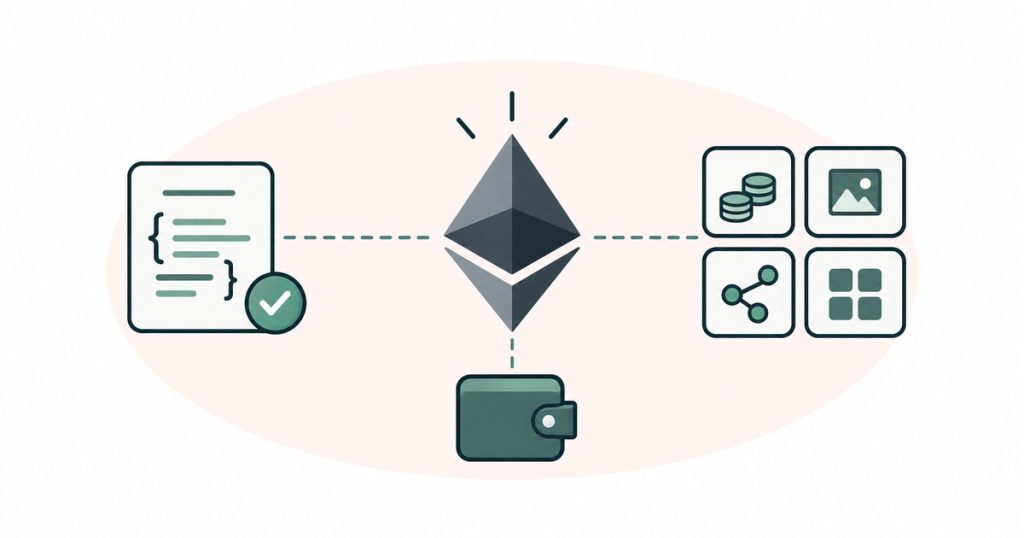
Ethereum is one of the best-known crypto networks and the first where “smart programs” — smart contracts — truly caught on (what they are — in the article smart contract). A smart contract is a program written straight into the network that carries out a set rule on its own, with no intermediary. On Ethereum you can program almost any logic, which is why most tokens, stablecoins, NFTs, and in-network apps run right here. If Bitcoin was conceived as “electronic cash,” Ethereum is more of a “big shared computer” on top of which everything else is built.
The network was devised by Vitalik Buterin with a team of co-founders, and it went live on 30 July 20151. The idea of such a network — a programmable “world computer” — was set out by Vitalik Buterin before launch in the technical document (whitepaper)4. It helps not to confuse two names: Ethereum is the network itself, while its coin is properly called Ether, ETH for short. In practice, though, almost no one keeps that distinction: the ticker ETH long ago stuck to the name Ethereum, and it is too late to re-teach it, so ETH and Ethereum are usually taken to mean the same thing — the network’s coin, which you pay for any operation inside it with.
Ethereum is secured by a method called Proof of Stake, literally “proof of a stake.” Whereas Bitcoin is secured by computation, here it works differently: a participant called a validator freezes part of their coins as a pledge of honest behavior, and this is what is called staking. While the pledge is frozen, the rules of the network let the validator take a turn assembling a new block of records and get a reward for it, and if they try to cheat, part of their pledge is burned as a penalty, which is called slashing. Earlier, before September 2022, Ethereum was secured by computation, like Bitcoin, and then the network switched to pledges2. More in what is consensus and miners and validators. A new block of records appears roughly every 12 seconds, noticeably faster than Bitcoin.
For every transfer or action in the network you pay a small fee, and on Ethereum it is called “gas” — by analogy with the fuel an operation “runs on.” It is paid in ETH, and its size depends on how complex the operation is and how busy the network is right now: when there are many operations, the fee is higher. More in what is gas.
How many coins there will be is not fixed on Ethereum. This is called issuance — how new coins appear — and there is no limit here like Bitcoin’s 21 million. At the same time the network “burns” part of the fees, that is, those coins are removed from circulation forever, so the total number sometimes grows a little and sometimes shrinks a little (more in issuance). Part of the coins were also handed out in advance: unlike Bitcoin, a share of ETH was distributed before launch, through an open sale in 2014, which raised 31,000 BTC. When coins are handed out in advance, before any mining, this is called a premine, and it is simply a fact about how they were distributed at the start, without judgment1.
Ethereum’s main feature is smart contracts, and tokens (what is a token), stablecoins (what is a stablecoin), NFTs, and in-network apps all rest on them. An Ethereum address starts with “0x…”, and the same address works both for ETH and for tokens of this network, but when sending, it matters that the network matches (see how to send crypto).
There are also exchange-traded funds for Ethereum, called ETFs: through such a fund you can get exposure to the price of ETH from an ordinary brokerage account, without buying the coin itself. Spot Ethereum ETFs have traded in the US since 20243. The list of funds changes.
Where to check current Ethereum data
- Price, fee size (gas), number of confirmations, how many coins there are right now — where to check: an Ethereum network explorer.
- The current list of spot ETFs.
Properties
- The network's "fuel" — paying for operations (gas)
- A deposit for taking part in securing the network (staking)
- An asset to hold
ETH is not a stable coin: its price can swing sharply up and down (stable coins are built differently — see what is a stablecoin). Staking, that is freezing ETH for a reward, is not “risk-free interest”: it carries its own risks, including that very slashing penalty. As everywhere in crypto, keeping your coins safe is on you alone: there is no bank here that will restore your access — how to handle that is covered in what is a seed phrase and how to store crypto.